
 Available in US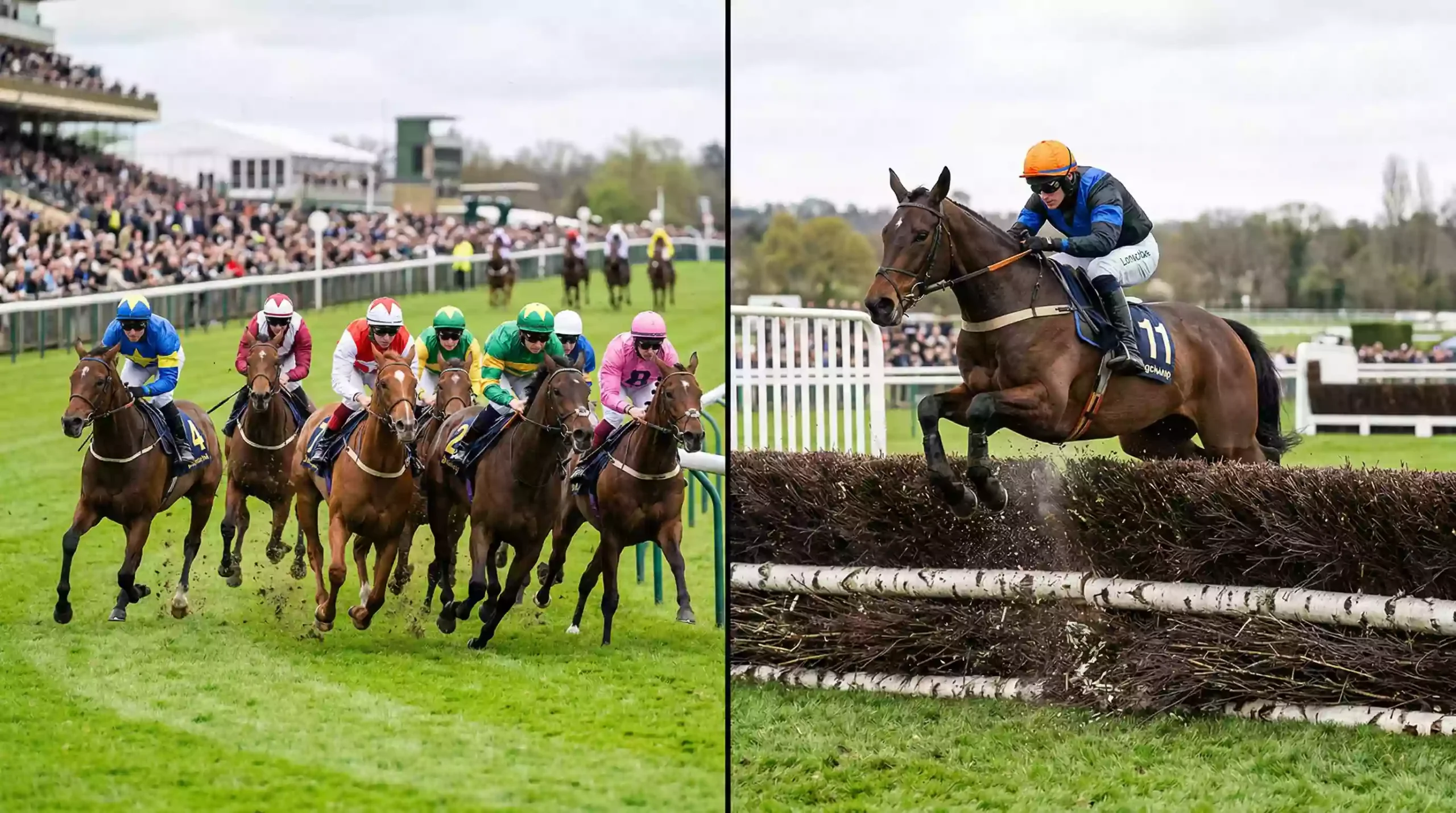
Flat rewards speed readers. Jumps reward patience. That one-line summary captures a genuine difference between the two codes of British horse racing, but it barely scratches the surface of what a punter needs to understand before choosing where to focus their form study. Flat and National Hunt racing share a species, a betting market and a general framework of racecards and form figures — but the selection challenges they present are fundamentally different.
The question punters actually want answered is not which code is better, but which code is easier to beat. And the honest answer is that neither is easy, but each favours a different type of analyst. This article breaks down the structural, statistical and practical differences between flat and jumps from a betting perspective, so you can decide where your method — and your temperament — will be most productive.
The most visible difference is obstacles. Flat racing has none. National Hunt racing has hurdles (smaller, flexible frames that horses jump at speed) and fences (larger, stiffer obstacles that demand a different technique). The presence of obstacles introduces a variable that flat racing simply does not have: a horse can be the best animal in the field on ability and still lose because it makes a jumping error, falls, or unseats its rider. This non-completion factor is fundamental to understanding NH form.
Field sizes differ substantially. Flat handicaps in Britain commonly attract 10 to 20 runners, particularly in competitive summer handicaps at major festivals. National Hunt races tend to have smaller fields — typically 6 to 14 — partly because the horse population is smaller and partly because the physical demands of jumping reduce the number of horses capable of competing at any given level. Smaller fields should, in theory, make selection easier. In practice, the unpredictability introduced by jumping offsets this advantage.
Distances diverge too. Flat racing spans from five furlongs (roughly one kilometre, over in less than a minute) to two miles and six furlongs at the extreme. National Hunt races start at about two miles over hurdles and extend to four miles and more in the most extreme steeplechases. The longer distances in NH racing mean that stamina, jumping endurance and the ability to sustain effort over extended periods become critical factors that barely exist in flat sprints. A flat sprint is a test of pure speed. A three-mile chase is a test of speed, stamina, jumping ability, courage and fitness combined.
These structural differences shape the form you need to read. On the flat, speed figures, draw data and class are the dominant factors. In National Hunt, going preference, completion rate and the ability to handle specific types of obstacle join the equation — and sometimes outweigh the conventional form indicators entirely.
The simplest measure of predictability in any sport is how often the favourite wins. In horse racing, the answer varies between codes — and the variation tells you something important about where edges are more likely to exist.
Across all British racing, a 20-year study of results from 2002 to 2021 found that the favourite wins approximately 34 percent of the time. The second favourite wins about 20 percent, and the third favourite around 13 percent. Those figures represent the aggregate across flat and NH combined, according to data compiled by Betting Offers UK.
National Hunt racing tends to produce lower favourite strike rates than the flat, particularly in the bigger festivals. At the 2024 Grand National Festival, favourites won 7 of 21 races — a 33 percent strike rate that sounds respectable until you consider the context. The Grand National meeting is one of the most competitive in the calendar, and the overall favourite strike rate across NH racing as a whole sits below the flat average. The reason is structural: jumping errors, falls, loose horses and the attrition of long-distance races all introduce randomness that suppresses the market’s ability to identify the winner in advance.
On the flat, small-field conditions races and Group events tend to produce higher favourite strike rates because the quality gap between runners is often wider and the elimination of obstacles removes a major source of unpredictability. A two-year-old maiden with six runners on fast ground at Newmarket is a more predictable event than a 16-runner novice hurdle on heavy ground at Uttoxeter.
For punters, the implication is nuanced. Lower favourite strike rates in NH do not necessarily mean better value — they can also mean more randomness that is hard to exploit systematically. Higher favourite strike rates on the flat do not mean the flat is easy to beat — they mean the market is more efficient, which compresses the available edge. The code that suits you depends on whether your method thrives in high-information, high-efficiency environments (flat) or lower-information, higher-variance environments (jumps).
The quantity and quality of available data differs markedly between the two codes, and this has practical consequences for how you build your method.
Flat racing generates vastly more data. The UK flat season runs from April to November on turf and year-round on all-weather surfaces, producing thousands of races annually. Speed figures are more reliable on the flat because the shorter distances and absence of obstacles make time-based analysis cleaner. Draw bias data exists for every UK flat course and is updated continuously. Class par figures are well-established. Trainer and jockey statistics are available in detail, with large sample sizes that support meaningful analysis.
National Hunt data is thinner. The NH season runs primarily from October to April, with a smaller fixture list and fewer runners per meeting. Speed figures are harder to interpret over jumps because the times include time spent in the air over obstacles, which varies by horse and fence. Draw bias is largely irrelevant over jumps (there are no stalls in most NH races). According to analysis by BetTurtle, even televised NH race data — the most closely scrutinised subset — is concentrated among a relatively small number of trainers: Paul Nicholls led with 63 wins over the 2022-2024 period, while Nicky Henderson posted the best strike rate at 19.55 percent. The dominance of a few major yards makes trainer analysis simultaneously more important and more predictable in NH than on the flat.
The data gap means that flat racing suits punters who enjoy building models, running filters and working with large datasets. NH racing suits punters who prefer deep qualitative analysis — watching replays, studying jumping technique, understanding individual horses’ preferences over repeated campaigns. Both approaches are valid, but they demand different skills and different time investments.
There is no objectively easier code. There is only the code that better suits your analytical style, your available time and your tolerance for variance.
If you enjoy working with numbers — speed figures, draw data, large-sample statistics — and you find satisfaction in systematic filtering, flat racing will feel more natural. The data is richer, the sample sizes are larger, and the absence of obstacles removes a layer of randomness that can frustrate even the best analysis. Your edge on the flat comes from processing information more accurately than the market, which demands precision and discipline.
If you prefer a more intuitive, knowledge-based approach — learning individual horses over multiple seasons, understanding how they handle specific conditions, watching replays to assess jumping ability — National Hunt racing offers a different kind of reward. The smaller horse population means you can develop genuine expertise on specific animals. The higher variance means that when your knowledge identifies a live contender the market has underestimated, the price available is often more generous than it would be on the flat.
Many serious punters work across both codes, adjusting their method seasonally. They focus on flat handicaps through the summer, switch to NH novice hurdles and chases through the winter, and target the major festivals — Cheltenham, Aintree, Royal Ascot, Glorious Goodwood — where their preparation delivers the highest return. That blended approach is probably the most productive long-term strategy, because it means you are always working in the code where the current opportunities are richest.
