
 Available in US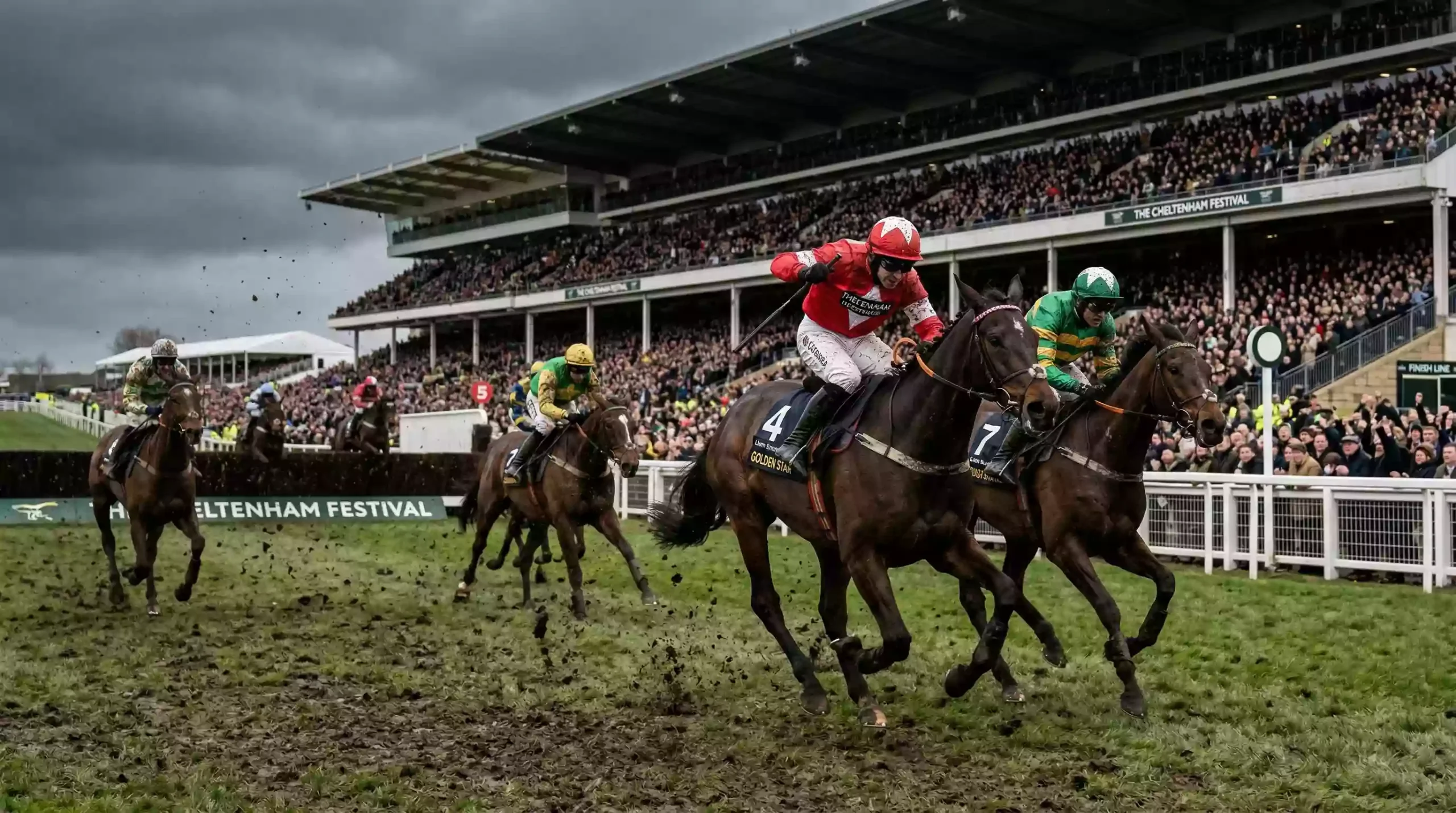
Cheltenham is where form meets courage — and ground meets everything. The Festival is not just the biggest meeting in National Hunt racing. It is the meeting that exposes every weakness in a horse’s profile and every gap in a punter’s method. Four days, 28 races, the best jumpers from Britain and Ireland colliding on a track that climbs, falls and turns in ways that flatten pretenders. The atmosphere adds a layer that form cannot quantify: horses that cruise through quiet midweek meetings sometimes find the Festival’s noise, pace and intensity too much.
For punters, Cheltenham is simultaneously the most rewarding and the most humbling week of the year. The information advantage available to those who prepare properly is real — the form angles that work at Cheltenham are specific, repeatable and backed by data. But the meeting also punishes overconfidence, because the variables that matter most — going, Irish raider strength, trainer intention — interact in ways that resist simple models. This guide isolates the factors that have the strongest predictive record at the Festival and shows you how to combine them into a practical selection process.
The single most important variable at the Cheltenham Festival is the going. This is not opinion — it is a structural feature of the calendar. The Festival takes place in March, the month when UK racing surfaces are at their most testing. According to analysis by BetTurtle, 58 percent of first-quarter races in Britain run on Soft or heavier going. Cheltenham’s Prestbury Park location in the Cotswolds, with its clay-based soil and exposure to Atlantic weather systems, means that the Festival ground is almost always on the soft side of Good, and frequently Soft or Heavy.
What this means for selection is straightforward: horses that cannot handle testing ground should be treated with extreme caution at Cheltenham, regardless of how impressive their form looks on better surfaces. A horse that has won three Grade 2 hurdles on Good ground but has never encountered Soft may find the Festival a brutal education. Conversely, a horse with a modest record on good ground but a win or strong placing on Soft at a significant track is a more Cheltenham-ready proposition than its headline form suggests.
The going also interacts with Cheltenham’s unique topography. The track features a significant hill on the far side, a descent into the back straight and an uphill finish that tests stamina in the final furlong. On soft ground, that hill becomes a wall. Horses that are not genuine stayers — those that rely on speed rather than stamina to see out their trips — find the combination of soft ground and the Cheltenham hill too much. This is why you will regularly see horses that looked comfortable winning at flat, fast tracks like Kempton struggle at Cheltenham: the course asks different questions, and the going amplifies every one of them.
The practical rule is simple. Before you assess any Cheltenham contender, check its going record. If there is no evidence it handles Soft or worse, it is a risk — and at a festival where 28 races compress into four days, you do not need to take risks on unproven ground horses when proven ones are available.
No analysis of the Cheltenham Festival is complete without acknowledging the Irish-trained contingent. In recent years, Ireland has dominated the meeting to a degree that would have been unimaginable two decades ago. The shift is not subtle: in 2023 and 2024, Irish-trained runners won the majority of races across the four days, and the pattern shows no sign of reversing.
The dominance is driven by a combination of factors. Irish National Hunt racing has a deeper talent pool than its British equivalent, with more horses entering the sport through the point-to-point system that serves as a feeder league for professional NH racing. The Irish training centres — particularly those in the Closutton, Cullentra and Ballymore regions — produce horses on ground that is often softer and more testing than typical British conditions, which means Irish-trained runners arrive at Cheltenham already conditioned for the going.
Willie Mullins is the central figure. His operation at Closutton in County Carlow is the largest and most successful jumps yard in the world, and his Festival record over the past decade is extraordinary. According to NH televised race data compiled by BetTurtle, Mullins has compiled a massive presence in the biggest races — though his overall ROI in televised races sat at minus 33.41 percent over the 2022-2024 period, reflecting the short prices his runners frequently start at. The lesson for punters is that Mullins runners are usually the right horses but not always the right bets. His Festival record is formidable, but his prices often leave no margin for error.
As Mullins himself has said about targeting big races: when you see a horse with ability, you mind that ability and produce it on the days that count. That philosophy — the careful management of talent towards specific targets — explains why Irish runners are so consistently ready for the Festival. They are not incidentally at Cheltenham; they have been aimed at it for months.
Beyond Mullins, a small group of trainers consistently shape the Festival results, and knowing their patterns gives you an edge in pre-race analysis.
Paul Nicholls, based in Ditcheat, Somerset, is Britain’s most successful active NH trainer and leads all British-based handlers at the Festival. His tally of 63 wins in televised NH races over the 2022-2024 period reflects the depth and quality of his operation. Nicholls is a trainer who targets specific races with specific horses — he does not scatter entries across the card hoping to get lucky. When a Nicholls runner is declared for a Festival race, it is usually because the horse’s profile matches the demands of that particular contest. His record is strongest in staying chases and in the novice categories, where he has a long history of producing well-prepared debutants at the highest level.
Nicky Henderson, operating from Seven Barrows in Lambourn, has the best overall strike rate among Britain’s big three NH trainers at 19.55 percent in major televised races. Henderson’s Festival record is particularly strong in the championship hurdles — the Champion Hurdle and the Triumph Hurdle — and he tends to produce hurdlers that are quicker and sharper than the typical staying types favoured by Nicholls. If Henderson runs a horse in a Festival hurdle, the horse has usually been specifically prepared for that race rather than simply turning up as part of a broader campaign.
Gordon Elliott and Henry de Bromhead represent the next tier of Irish trainers with strong Festival records. Both have produced Grand National and Gold Cup winners, and both bring significant numbers of runners to the meeting each year. Their runners deserve the same respect as Mullins’ in terms of Cheltenham-readiness, though their individual race targeting can be harder to read because they handle slightly smaller strings.
The practical application of trainer data at Cheltenham is not to back every runner from a big yard. It is to understand which trainers are most likely to have their runners at peak readiness for the specific race they are contesting. A Mullins novice hurdle runner at the Festival is a trained weapon. A first-time Festival runner from a small yard with no track record at the meeting is a speculative bet regardless of its form elsewhere.
A workable Cheltenham selection method does not need to be complicated, but it does need to prioritise the factors that matter most at the Festival. Here is a framework built on the data covered above.
Start with the going. Check each contender’s record on Soft ground or worse. If a horse has never run on testing ground, or has run poorly when it has, move it down your shortlist. Cheltenham in March is not the place to hope a horse handles conditions it has never faced.
Next, assess the trainer’s Festival pedigree. A runner from a yard with a proven track record at the meeting — Mullins, Nicholls, Henderson, Elliott, de Bromhead — starts with a structural advantage. These trainers know how to prepare horses for the specific demands of Prestbury Park. Factor in whether the horse appears to be a targeted runner (entered in one specific race) or a speculative entry (declared for multiple options during the week). Targeted runners are more likely to arrive at peak readiness.
Then evaluate the form through a Cheltenham lens. Grade 1 and Grade 2 trial form from Leopardstown, Sandown, Haydock and Cheltenham itself carries the most weight because those races test similar attributes. Form from flat tracks, fast ground or weak fields should be downgraded. Look specifically for horses that finished strongly up a hill or on testing ground, because those runs translate directly to the Festival’s demands.
Finally, check the price. The quality of the Cheltenham market means that most of the obvious contenders are priced accurately. The value lies in horses that tick the going, trainer and form boxes but are overlooked because their headline form is less impressive than the favourites’. A horse that won a Grade 2 trial on Soft ground, trained by a top Festival handler, but is 10/1 because it has only won twice in eight starts, is often a better bet than the short-priced favourite whose record on soft ground is untested.
The Festival rewards preparation and punishes shortcuts. The punters who do best are not the ones who find a single magic formula — they are the ones who systematically apply the going filter, the trainer filter and the form filter, and then let the price tell them where the value sits.
