
 Available in US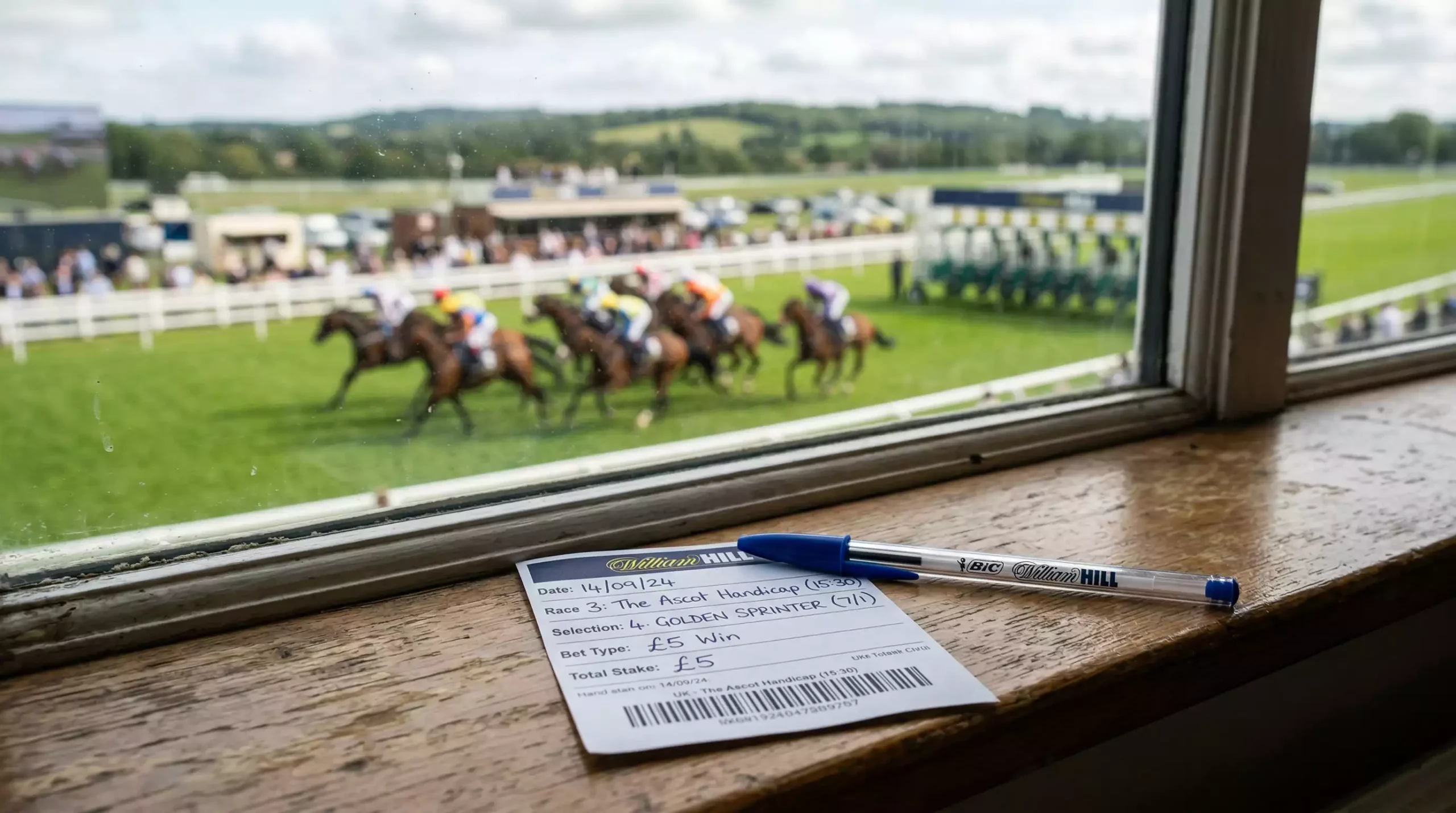
Each way is not a safety net — it is a different bet with different maths. Most punters treat each-way betting as a softer version of a win bet: “I think this horse can win, but just in case, I will go each way.” That framing is wrong, and it leads to each-way bets that destroy value rather than create it. An each-way bet is two separate bets — one on the horse to win and one on the horse to place — and each half has its own expected value. Understanding when the place part adds genuine mathematical value, and when it merely doubles your losses, is the difference between using each way as a tool and using it as a comfort blanket.
An each-way bet consists of two equal stakes. If you bet £5 each way, your total outlay is £10: £5 on the horse to win and £5 on the horse to place. The win part pays at the full odds if the horse wins. The place part pays at a fraction of the odds if the horse finishes in the place positions defined by the race terms.
The place terms vary by field size and race type. In races with 5 to 7 runners, bookmakers typically pay 1/4 of the odds for the first two places. In races with 8 to 15 runners, they pay 1/5 of the odds for the first three places. In handicaps with 16 or more runners, some bookmakers extend to 1/4 of the odds for four places. These are standard industry terms, though they can vary — particularly when bookmakers offer enhanced each-way terms as a promotion.
The maths works like this: if you back a horse at 10/1 each way (£5 each way, £10 total), and the horse wins, you receive £50 profit from the win part (10/1 x £5) plus £12.50 from the place part (10/1 x 1/4 x £5 = 2.5/1 x £5), plus both stakes back — a total return of £72.50 on a £10 outlay. If the horse places but does not win, you lose the £5 win stake but receive £12.50 from the place part plus your £5 place stake back — a return of £17.50 on your £10 outlay, for a profit of £7.50.
The crucial point is that the place part has its own implied odds. At 10/1 with 1/4 odds, the place part is effectively a bet at 2.5/1. Whether that represents value depends on whether the horse’s chance of placing exceeds what 2.5/1 implies — roughly 28.6 percent. If you believe the horse has a 40 percent chance of placing, the place part alone is a value bet. If you believe it has a 20 percent chance, the place part is a losing proposition even though it feels like insurance.
Each-way betting adds genuine value in specific circumstances, and the common thread is the relationship between the place terms offered and the horse’s realistic chance of placing.
Big-field handicaps. In a 20-runner handicap where the bookmaker pays four places at 1/4 odds, the each-way bet captures a wide range of positive outcomes. A horse at 14/1 with a 1/4 place fraction gives you an effective place bet at 3.5/1. If the horse has a genuine 30 to 35 percent chance of finishing in the first four — not unreasonable for a well-fancied contender in a competitive handicap — the place part is excellent value. This is the scenario where each-way betting is most clearly superior to win-only.
The price band matters. Data from FlatStats shows that odds-on favourites win roughly 59 percent of their races. At those prices, each-way is pointless — the horse either wins or it does not, and the place return at 1/4 of odds-on is negligible. Each-way value increases as the odds get longer, because the gap between the win probability and the place probability creates room for the place fraction to generate positive expected value.
Enhanced each-way promotions. Bookmakers occasionally offer enhanced terms — extra places, larger fractions — on selected races, particularly at major festivals. These promotions can shift the mathematics significantly. A race where the standard terms are 1/5 for three places but a bookmaker offers 1/4 for four places has a materially better each-way profile. Hunting for the best each-way terms is one of the few genuinely easy edges available to punters, and it requires nothing more than comparing offers across multiple bookmakers before placing the bet.
Each way is not the only option for punters who want to cover the place. Betting exchanges offer place-only markets, and the choice between win-only, each way and place-only depends on where you believe the value lies.
Win-only is the right choice when you believe a horse’s chance of winning is underestimated by the market but its chance of placing is approximately fairly priced. In this scenario, the win part of an each-way bet captures the value while the place part dilutes it — you are paying an extra stake for a place bet that offers no edge.
Place-only — available on Betfair and other exchanges — is the right choice when you believe a horse has a much better chance of placing than winning. Academic research by Ali, published through the University of California, Berkeley, found that horse racing markets are generally efficient for win betting but can be exploitable through place and show bets where the pricing is less precise. A horse at 20/1 that you assess as a likely top-four finisher but an unlikely winner may be better served by a place bet on the exchange at tighter odds than by an each-way bet where the win half has almost no chance of landing.
Each way is the right choice when you believe the horse has a realistic chance of winning and a strong chance of placing — and the place terms offered by the bookmaker create positive expected value on the place part. This typically means horses in the 6/1 to 20/1 range in big-field races with generous place terms.
The biggest each-way trap is backing short-priced horses each way. A horse at 3/1 in a seven-runner race, with 1/4 the odds for two places, gives you a place bet at 3/4. That means your place part needs the horse to place more than 57 percent of the time to break even — and in a seven-runner race where only two places count, that is a tough ask even for a favourite. At short prices in small fields, each way almost always destroys value.
The second pitfall is assuming that each way is always safer. It doubles your stake, which means your total exposure is twice what it would be for a win-only bet. If the horse finishes fourth in a race that pays three places, both halves of your bet lose. You have not hedged your risk — you have doubled it. Each way only provides genuine protection when the place terms create a viable standalone bet.
Simon Rowlands, the former Timeform analyst, has emphasised that engaging seriously with the numerical side of racing — understanding the probabilities, not just the names and colours — is what separates the form student from the casual punter. Each-way betting is a perfect example: the punter who understands the place-part maths will only bet each way when the numbers work. The punter who does not will bet each way every time, on every horse, and slowly erode a bank that could have been profitable with win-only selections.
