
 Available in US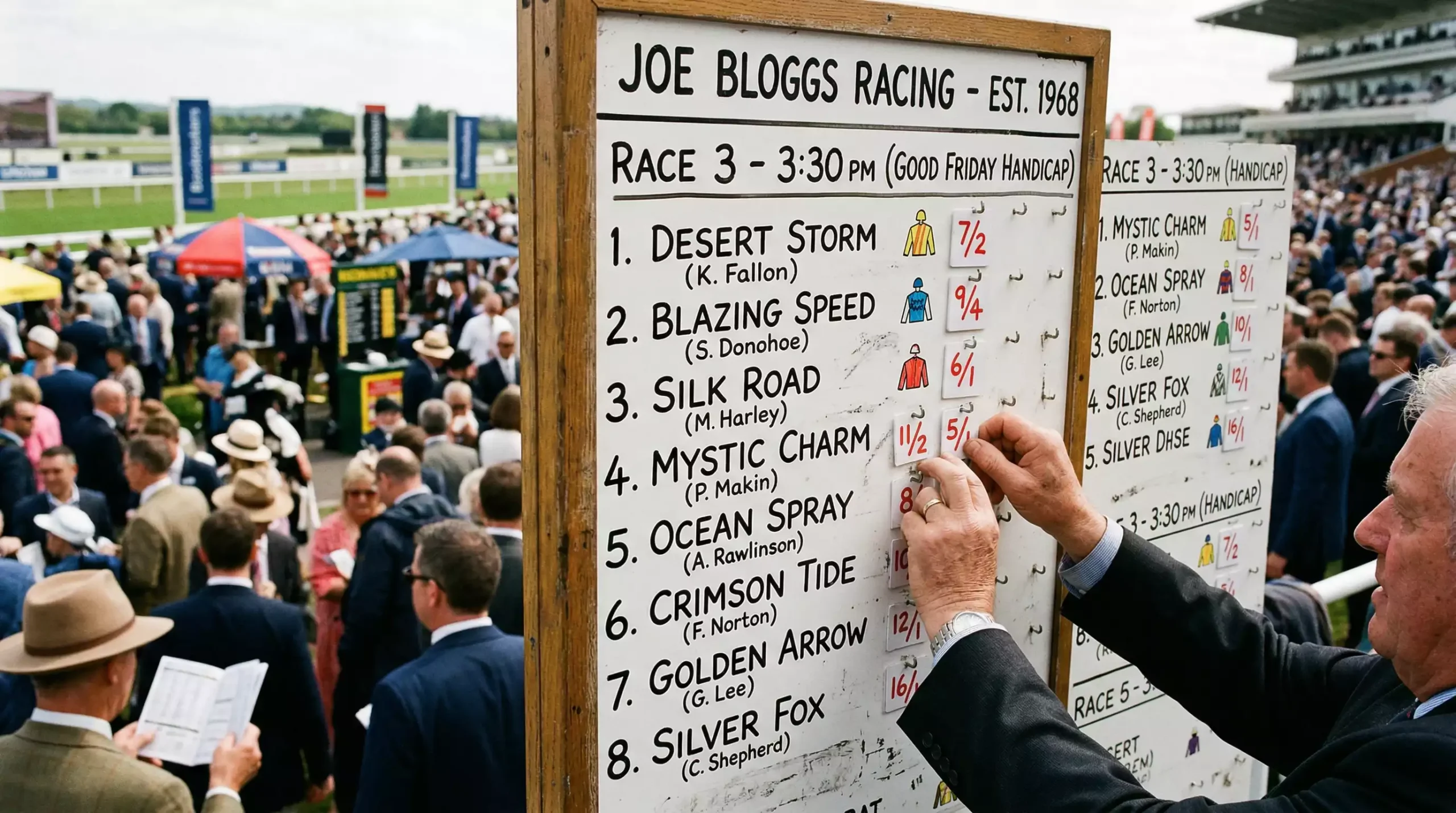
Odds are a language. You cannot find value until you are fluent. Every price on a racecard — whether displayed as 5/1, 6.0 or +500 — is a statement about probability. It tells you, in compressed form, what the market thinks a horse’s chance of winning is. If you cannot translate that statement into a percentage, you cannot compare it against your own assessment, which means you cannot determine whether the bet offers value. And without value, you are donating money to the bookmaker, slowly and surely, one bet at a time.
This guide demystifies the three odds formats used in horse racing, teaches you to convert between them, explains the concept of implied probability, and shows you how the bookmaker’s overround builds in a profit margin that punters must overcome to win in the long run.
Fractional odds are the traditional UK format. A horse at 5/1 (spoken as “five to one”) means you win £5 for every £1 you stake, plus your stake back. At 2/1, you win £2 per £1. At 1/2 (odds-on), you win £1 for every £2 you stake. Fractional odds are intuitive for British punters who grew up with them, but they are cumbersome for calculation — particularly when comparing prices like 11/8 and 6/4, which are close in value but not immediately obvious as such.
Decimal odds are standard on betting exchanges and increasingly common on bookmaker sites. The decimal figure represents the total return per unit staked, including the stake. A horse at 6.0 (equivalent to 5/1) returns £6 for every £1 staked — £5 profit plus the £1 stake. At 3.0 (2/1), the return is £3. At 1.5 (1/2), it is £1.50. Decimal odds are easier to compare, easier to calculate and more precise for fractional values. For most form-analysis purposes, decimals are the superior format.
American odds (also called moneyline) are rare in UK horse racing but appear on international platforms and some exchanges. Positive numbers (+500 = 5/1) show how much you win on a £100 stake. Negative numbers (-200 = 1/2) show how much you need to stake to win £100. Unless you are betting on US racing or using an American-facing platform, you will rarely encounter this format in UK racing, but the conversion principle is the same: all three formats encode the same information about probability and return.
The conversion between formats is mechanical. To convert fractional to decimal: divide the fraction and add 1 (5/1 = 5.0 + 1 = 6.0). To convert decimal to implied probability: divide 1 by the decimal odds (1 / 6.0 = 0.167 = 16.7 percent). These conversions are worth practising until they become automatic, because implied probability — not the odds format — is the number that tells you whether a bet is worth making.
Implied probability is the percentage chance of winning that the odds represent. It is the most important concept in betting literacy because it translates the bookmaker’s language into the punter’s language — a percentage you can compare against your own assessment.
The formula is simple: implied probability = 1 / decimal odds x 100. At 2.0 (evens), the implied probability is 50 percent. At 3.0 (2/1), it is 33.3 percent. At 11.0 (10/1), it is 9.1 percent.
Real data illustrates why this matters. According to analysis by FlatStats, odds-on favourites on UK flat turf win approximately 59 percent of the time. An odds-on horse at 1/2 (decimal 1.5) has an implied probability of 66.7 percent. If the actual win rate is 74 percent for horses at 1/2 and shorter, the horse is winning more often than the odds imply — which means, in this specific price band, there is a small long-term edge to backing them. At longer prices, the picture reverses: 8/1 favourites win only about 8 percent of the time, while the implied probability at 8/1 (decimal 9.0) is 11.1 percent. The market overestimates their chance, and backing them is a losing strategy.
The core skill of value betting is comparing your assessed probability against the implied probability. If you believe a horse has a 25 percent chance and the odds are 5/1 (implied probability 16.7 percent), you have found a value bet — the market is underestimating the horse. If you believe a horse has a 10 percent chance and the odds are 8/1 (implied probability 11.1 percent), there is no value — the market’s assessment is roughly aligned with yours or slightly overestimates the horse. The arithmetic is simple. The challenge is making your probability assessment accurate.
If you add up the implied probabilities of every horse in a race, the total will exceed 100 percent. The amount by which it exceeds 100 is the overround — the bookmaker’s built-in margin. A typical UK horse racing market has an overround of 115 to 130 percent, meaning the bookmaker is effectively selling 115 to 130 pence worth of probabilities for every 100 pence of actual probability. The extra is their profit margin.
The overround is the structural advantage that bookmakers hold over punters. It means that even a perfectly calibrated bettor — one who assesses every horse’s probability with complete accuracy — will lose money if they bet at bookmaker prices without selectivity, because the prices are systematically lower than fair value. Remote horse racing betting in the UK generated £766.7 million in gross gambling yield in the year ending March 2025, according to the Gambling Commission. That yield comes largely from the overround.
Betting exchanges reduce the overround significantly because the prices are set by market participants rather than by a bookmaker’s margin model. The typical Betfair exchange market on horse racing has an overround close to 101 to 103 percent, which means the prices are much closer to true probabilities. The commission on winning bets (usually 5 percent) replaces the overround as the exchange’s revenue model. For value-conscious punters, the exchange’s tighter margins make it the more efficient platform for bet execution.
Three pricing options face the UK horse racing punter: the bookmaker’s early price, the starting price (SP), and the Betfair Starting Price (BSP). Each has its use, and choosing the right one at the right time is a skill in itself.
Early price is the price offered by bookmakers in the morning or even the night before a race. Early prices are often the best value because the bookmaker is building the market and may offer more generous odds to attract initial bets. If you believe a horse will shorten (attract money and move to a shorter price) during the day, taking the early price locks in the higher return.
SP (starting price) is the price returned at the moment the race starts, calculated from the on-course bookmakers’ boards. SP is the fallback for many punters who do not take an early price — it is what you receive if you bet “SP” with an online bookmaker. The SP is typically tighter than the early price on horses that have been well backed, and sometimes more generous on horses that have drifted.
BSP (Betfair Starting Price) is calculated from the unmatched orders on the Betfair exchange at the off. BSP tends to be more generous than bookmaker SP because it reflects a market without overround. For punters using the exchange, BSP is often the most efficient default option — particularly for bets placed late in the day when the exchange market is at its most liquid and representative.
The practical rule is straightforward: if you have done your analysis early and believe the price will shorten, take the bookmaker’s early price. If you are betting closer to the off and want the fairest available market price, use BSP on the exchange. The time you take the odds matters almost as much as which horse you take them on.
