
 Available in US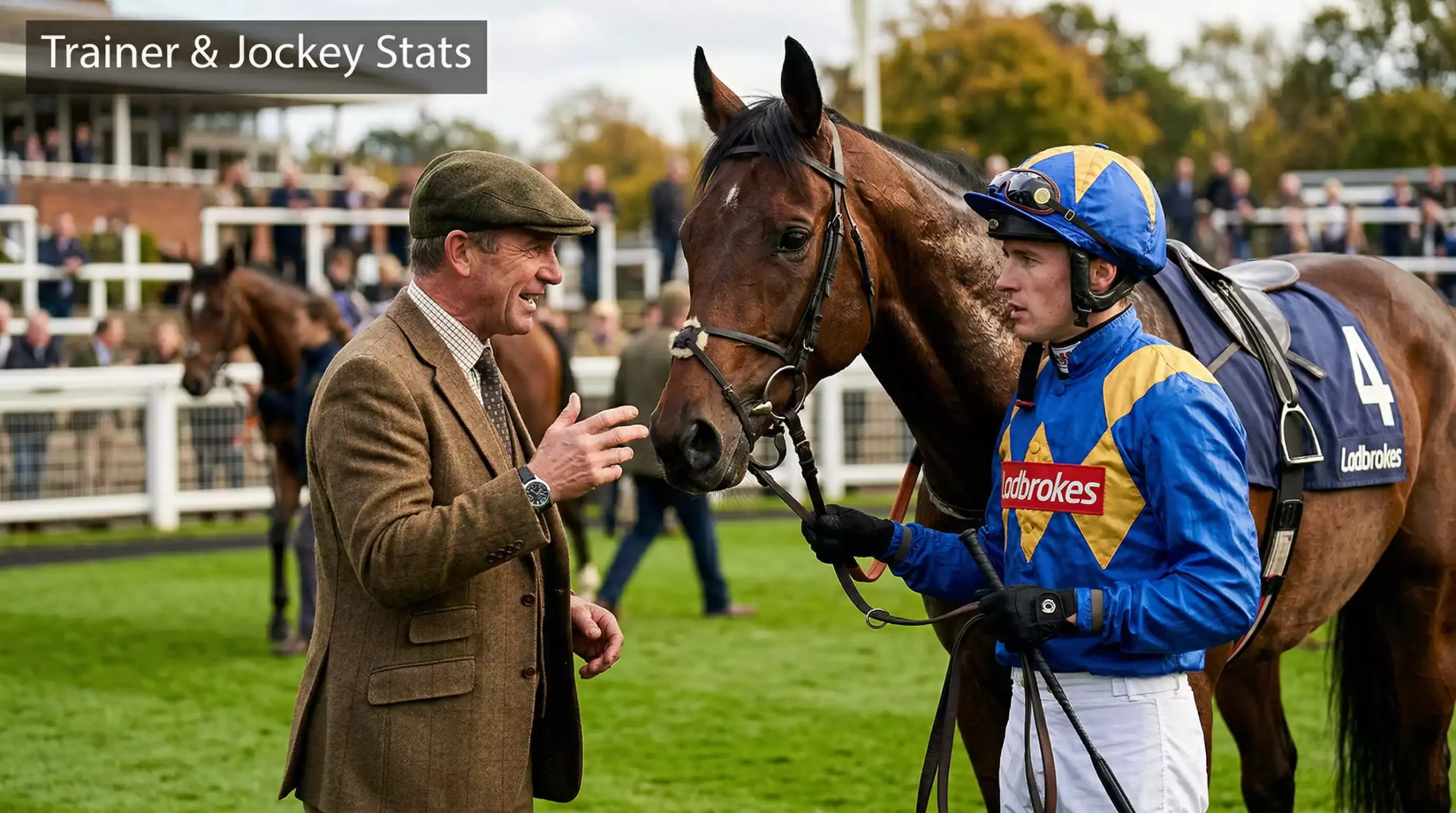
The name on the saddle cloth matters — but the numbers behind it matter more.
Every racecard tells you who trains a horse and who rides it. What most punters do with that information is instinctive and shallow: they recognise a big name, feel a vague sense of confidence, and move on. That is not analysis. It is brand recognition dressed up as form study. The actual value in connections data is quantitative — strike rates, course records, seasonal patterns, combination stats — and most of it is freely available to anyone willing to spend ten minutes looking it up.
Consider the gap between perception and data. In the 2025 UK Flat season, RaceShare data showed Andrew Balding leading the trainers’ championship with 110 winners from 553 runners — a 20 percent strike rate that earned over £3.2 million in prize money. Charlie Appleby, meanwhile, ran far fewer horses but won at a 33 percent clip: 52 winners from 160 starts. Both trainers are elite. But a punter who treats them identically is missing the point. Appleby’s runners carry a structurally higher baseline probability of winning on any given start. If two horses look equal on form and one is trained by a yard striking at 33 percent while the other comes from a yard at 12 percent, the difference is not cosmetic — it is statistical.
This guide breaks down how to read trainer stats, identify jockey patterns, evaluate trainer-jockey combinations, and interpret the signals that connections send before a race. The goal is not to replace form analysis with connections analysis — it is to add a layer that most punters either ignore or handle by gut feeling alone. Data from Inform Racing shows that 75 to 80 percent of all winners come from the top five in the betting market — and the connections behind those market leaders are a significant reason why the market rates them so highly in the first place.
Strike rate is the single most useful number in trainer analysis. It answers a simple question: of every 100 runners this trainer sends out, how many win? A trainer with a 25 percent strike rate wins roughly one in four. A trainer at 10 percent wins one in ten. The difference between those two numbers is the difference between a yard that is converting ability into results and a yard that is not — or, more often, a yard that runs horses more aggressively versus one that runs them opportunistically.
The 2025 UK Flat season illustrates this clearly. Balding’s 20 percent rate across 553 runners reflects a large stable running in quantity. Appleby’s 33 percent from 160 runners reflects a smaller, more selective operation where each runner is more likely to be at peak readiness. Neither approach is objectively better — they are different strategies, and each produces different betting implications. Backing every Balding runner blind would yield a lower hit rate but more total winners. Backing every Appleby runner blind would yield fewer runners but a significantly higher win frequency.
What makes strike rate genuinely useful is context. A headline rate of 20 percent tells you one thing. A 20 percent rate that breaks down to 30 percent at Newmarket and 8 percent at Wolverhampton tells you something far more actionable. Most stat databases — RaceShare, Racing Post, Timeform, ATR — allow you to filter trainer performance by course, distance, going, and race class. The punter who filters is working with a different dataset from the punter who glances at the headline number.
Trainer statistics are available from several sources, most of them free. RaceShare publishes regularly updated tables of UK trainer performance broken down by wins, runs, strike rate, and prize money. The Racing Post racecard includes a trainer’s recent form summary — typically the last 14 days — next to every runner. Timeform and At The Races offer deeper statistical profiles. For the serious form student, these tools are not optional extras. They are the raw material.
The key is knowing what to filter for. Overall strike rate is a starting point, not an endpoint. A trainer’s record at today’s specific course is more predictive than their national average. Their record with the type of horse in question — two-year-old debutants, handicappers off a mark, horses returning from a break — narrows the picture further. And their form over the last 14 to 28 days tells you whether the yard is currently firing or going through a quiet spell. Stables run hot and cold just like batsmen, and a yard that has sent out eight winners in the last fortnight is operating at a different level from one that has had two winners in a month.
One trap to avoid: sample size. A trainer who has had three runners at Chester and won with two of them shows a 67 percent strike rate at the course. That looks extraordinary — until you recognise that three runners is not a sample, it is an anecdote. As a rough rule, any stat built on fewer than 20 runners should be treated with scepticism. Thirty or more gives you something meaningful. Below that, you are reading noise.
Elite trainers do not distribute their runners randomly across the calendar. They target. They plan campaigns months in advance, placing horses at specific meetings where conditions align with ability. Understanding these patterns turns a name on a racecard into a predictive signal.
Seasonal patterns are the most visible form of targeting. Some trainers peak early in the flat season, sending their best two-year-olds to the first maidens of April and May when the opposition is at its weakest. Others build towards the autumn, preparing handicappers to peak when their mark is right and the ground has softened. In National Hunt racing, the targeting is even more pronounced. An analysis of televised NH races from 2022 to 2024, published by BetTurtle, found that Paul Nicholls led the way with 63 winners from the biggest televised events, while Nicky Henderson posted the highest strike rate at 19.55 percent. Willie Mullins, despite dominating in Ireland, showed a return on investment of minus 33.41 percent for backers in those same UK televised races — proof that a champion trainer’s overall record does not automatically translate into value in every market.
Willie Mullins himself has spoken about the philosophy behind targeting big races. “When you see a horse with ability, you mind that ability and produce it on the days that count,” he told BetTurtle in a 2024 interview. That mindset — conserving a horse for the right moment rather than running it into the ground — is what separates trainers who accumulate volume from trainers who accumulate the prizes that matter. For the punter, the implication is direct: a Mullins runner at the Cheltenham Festival is not the same proposition as a Mullins runner at a midweek card at Plumpton. The targeting changes the probability.
Some trainers have a measurably better record at certain courses. This is not random — it reflects proximity (yards near specific tracks run there frequently and understand the terrain), tactical preference (trainers whose style suits a particular course’s layout), and institutional knowledge built over years. A trainer based in Lambourn who regularly sends horses to Newbury will know that track’s undulations, its drainage patterns, and its draw tendencies in a way that a Newmarket-based rival does not.
Course-specialist data is available in the same databases that carry headline strike rates. The difference is that most punters never filter by course. They see a trainer’s name, check the overall percentage, and move on. The punter who drills down to course-level data is operating with a sharper tool. When a trainer’s course strike rate is double their national average — say, 30 percent at Haydock versus 15 percent overall — that is a signal worth acting on, especially if the horse’s form already looks competitive.
Targeting also extends to race type. Some trainers specialise in first-time-out runners, preparing horses at home and sending them to the track ready to win first time. Others excel with horses returning from a layoff, knowing how to bring them back to peak fitness through a specific sequence of outings. These specialisms are not hidden — they show up in the stats — but they require the punter to look for them rather than waiting for the information to appear on the racecard.
Jockey stats are seductive and misleading in roughly equal measure. A jockey’s overall win percentage tells you that they ride a lot of winners — or that they ride a lot of well-fancied horses, which is not the same thing. The top jockeys in Britain ride for the top stables, which means they are routinely on board the best horse in the race. Their win rate reflects the quality of their mounts at least as much as their ability in the saddle.
That does not mean jockey data is useless. It means you have to read it differently from trainer data. The most useful jockey metrics are situational: how does this rider perform on front-runners versus hold-up horses? What is their record when riding at a specific course? How do they handle soft ground compared to fast ground? These filters isolate the jockey’s tactical influence from the horse’s raw ability, and they occasionally reveal edges that headline stats obscure.
Place percentage is often more informative than win percentage for jockeys. A rider who wins 12 percent of the time but finishes in the first three 40 percent of the time is consistently getting horses into competitive positions — they are making tactical decisions that maximise each horse’s chance. A rider who wins 15 percent but places only 30 percent may be a more aggressive rider who goes for broke: brilliant when it works, costly when it does not. The style that suits today’s race depends on the horse’s running style, the likely pace, and the tactical demands of the course.
The most valuable piece of jockey data is not statistical at all — it is the booking itself. When a top jockey chooses to ride one horse over another in the same race, that decision contains information. Jockeys — especially retained riders with access to inside knowledge of the stable — know which horses are working well at home, which are expected to improve, and which are being aimed at a particular race. Their choice of mount is a form of expert opinion filtered through skin-in-the-game incentive. They do not ride for fun; they ride for a percentage of the prize money.
To fully understand the impact of riders, you should also analyze horse racing jockey bookings and what a sudden change signals to the market.
Find more data-driven strategies and statistical models on our horse racing prediction platform to increase your strike rate.
Watch for patterns in bookings. A freelance jockey who keeps returning to the same trainer for a specific horse is signalling something. A retained rider who picks up a spare ride in a race where their stable has no runner is worth noting — someone offered them the mount because they wanted the best available rider, and the jockey accepted because they thought the horse had a chance. These subtle booking decisions are invisible to the punter who only checks the jockey’s name. They are highly visible to the punter who tracks who rides what and why.
Individual stats tell one story. Combination stats tell a more nuanced one. A trainer with a 15 percent overall strike rate might hit 28 percent when a specific jockey rides their horses. That jump is not a fluke if the sample is large enough — it reflects a working relationship where the rider understands the trainer’s methods, knows how the horses are prepared, and makes better tactical decisions as a result.
The classic example in flat racing is the retained jockey arrangement, where a trainer’s principal owner employs a rider on a long-term contract. The Gosden-Dettori partnership, before it ended, produced results that neither party replicated to the same degree independently. More recently, combinations like William Buick and Charlie Appleby have shown that the chemistry between trainer and rider compounds over time. Buick does not just ride Appleby’s horses — he understands their preparation, their quirks, their preferred running positions. That understanding translates into race-day decisions that are better calibrated than a jockey meeting the horse for the first time.
You do not need to track every trainer-jockey combination in Britain. Focus on the yards you follow most closely and note which riders they use in which situations. Most trainers have a first-choice jockey, a second-choice, and a pool of freelancers they call on for specific tasks. When the first-choice rider is booked, it usually means the stable rates the horse. When the second-choice gets the call, the stable may be less confident — or the first-choice is committed elsewhere. When a freelancer is booked who has no prior record with the yard, it can mean the yard is trying something different, or it can mean the horse is not expected to contend and the booking is functional rather than strategic.
Racing Post and Timeform both allow you to filter results by trainer-jockey combination. The process takes less than a minute: search for the trainer, filter by jockey, and check the strike rate over the last one to three seasons. If the combination shows a meaningfully higher win rate than the trainer’s average — say, 25 percent versus 16 percent — and the sample exceeds 30 runners, you have a datapoint worth incorporating into your assessment.
The biggest mistake punters make with combination stats is treating them as standalone signals. A strong trainer-jockey combination running a horse that is out of form, on the wrong ground, at an unsuitable distance, is still a poor bet. Combination data is a multiplier, not a foundation. It amplifies existing positive signals — good recent form, suitable conditions, appropriate class — and slightly dampens negative ones. Used correctly, it separates two otherwise equal contenders. Used in isolation, it produces expensive opinions about horses that looked good on paper and lost on turf.
Connections send signals before every race. Some are loud: a first-time tongue-tie, a switch to a leading jockey, a drop in class. Others are quiet: a horse that drifts in the market despite good form, a trainer who offers no quotes to the press when they normally do, a stable that has gone cold after a hot streak. Learning to read these signals is the interpretive skill that sits on top of the statistical work.
Simon Rowlands, the former Timeform analyst, addressed this directly in a Q&A on The Racing Forum when he identified which types of information punters tend to overvalue and undervalue. In his assessment, trainer form and raw form data are undervalued by the betting public, while statements from trainers and jockeys — and trends — tend to be overvalued. That observation captures a core truth about connections analysis: what the people around the horse do is more informative than what they say. A trainer who claims their horse is “ready” but has not changed the jockey, the equipment, or the class is offering words, not evidence. A trainer who says nothing but books the stable’s best rider and drops the horse in trip is giving you a page of information in a single entry.
Market moves linked to stable confidence are another signal worth monitoring. When a horse’s price shortens significantly in the morning without any obvious public reason — no newspaper tip, no social media buzz — the implication is that money from informed sources is entering the market. Stables do not bet openly, but the network of owners, work riders, and associates creates an information chain that reaches the betting ring before it reaches the racecard. A 10/1 shot that is suddenly 7/1 at 10am may be reflecting nothing more than a good piece of work on the gallops that morning.
The discipline is to treat signals as supplementary, not primary. A horse that ticks every form box and also shows positive stable signals is a strong play. A horse that shows stable signals but has poor form is a rumour, not a bet. Connections analysis works best when it confirms what the numbers already suggest.
Connections analysis does not need to take half an hour. Once you know what to look for, you can assess the trainer and jockey angle for any runner in roughly five minutes. Here is the sequence that works.
Start with the trainer’s recent form. Check their last 14 days: how many runners, how many winners, what is the current strike rate? A trainer hitting at 25 percent over the last fortnight is in form. A trainer at 5 percent is not. This takes 30 seconds on any major racing site. If the trainer is running cold, it does not eliminate the horse, but it does lower your confidence. Stables go through flat patches — staff illness, a virus in the yard, a run of bad luck with the draw — and those patches are real. They show up in the numbers before anyone announces them publicly.
Next, check the trainer’s record at today’s course. If they have a 30 percent strike rate at Newbury but only 8 percent at Kempton, and today’s race is at Kempton, adjust accordingly. Course records over 30 or more runners are reliable. Below that, treat the data as suggestive rather than definitive.
Then check the jockey. Is this the trainer’s first-choice rider? If yes, the stable is serious about the horse’s chance. If it is a replacement booking — the first jockey is riding elsewhere — find out whether the replacement is an upgrade, a sidegrade, or a downgrade. An upgrade (a more experienced rider stepping in) is a positive signal. A downgrade (an apprentice replacing a senior jockey) may indicate the stable is less confident, or it may indicate the horse needs the weight allowance the apprentice claims. Context matters.
Check the trainer-jockey combination record if the pairing is not a regular one. A one-off booking of a freelance jockey who has never ridden for this yard tells you less than a regular partnership with a proven track record together.
Finally, look for non-statistical signals. Has the horse been fitted with new headgear? Has it been gelded since its last run? Has the trainer been quoted in the morning press about this horse? Is the price shorter than the form suggests it should be? None of these signals alone is enough to make a bet. But when the stats and the signals align — a trainer in form, at a course they excel at, with their first-choice jockey, on a horse whose price has shortened overnight — you have a confluence of positive indicators that justifies a higher degree of confidence in the selection.
Five minutes per horse, applied consistently, across every race you study. That is the routine. Consider the broader context: a 20-year study of British racing showed that market favourites win roughly 34 percent of the time, and the trainers and jockeys behind those favourites are disproportionately drawn from a small pool of elite connections. The connections data will not make you a winner on its own. But it will prevent you from backing horses where the trainer, the jockey, or both are quietly telling you the answer is no.
