
Loading...
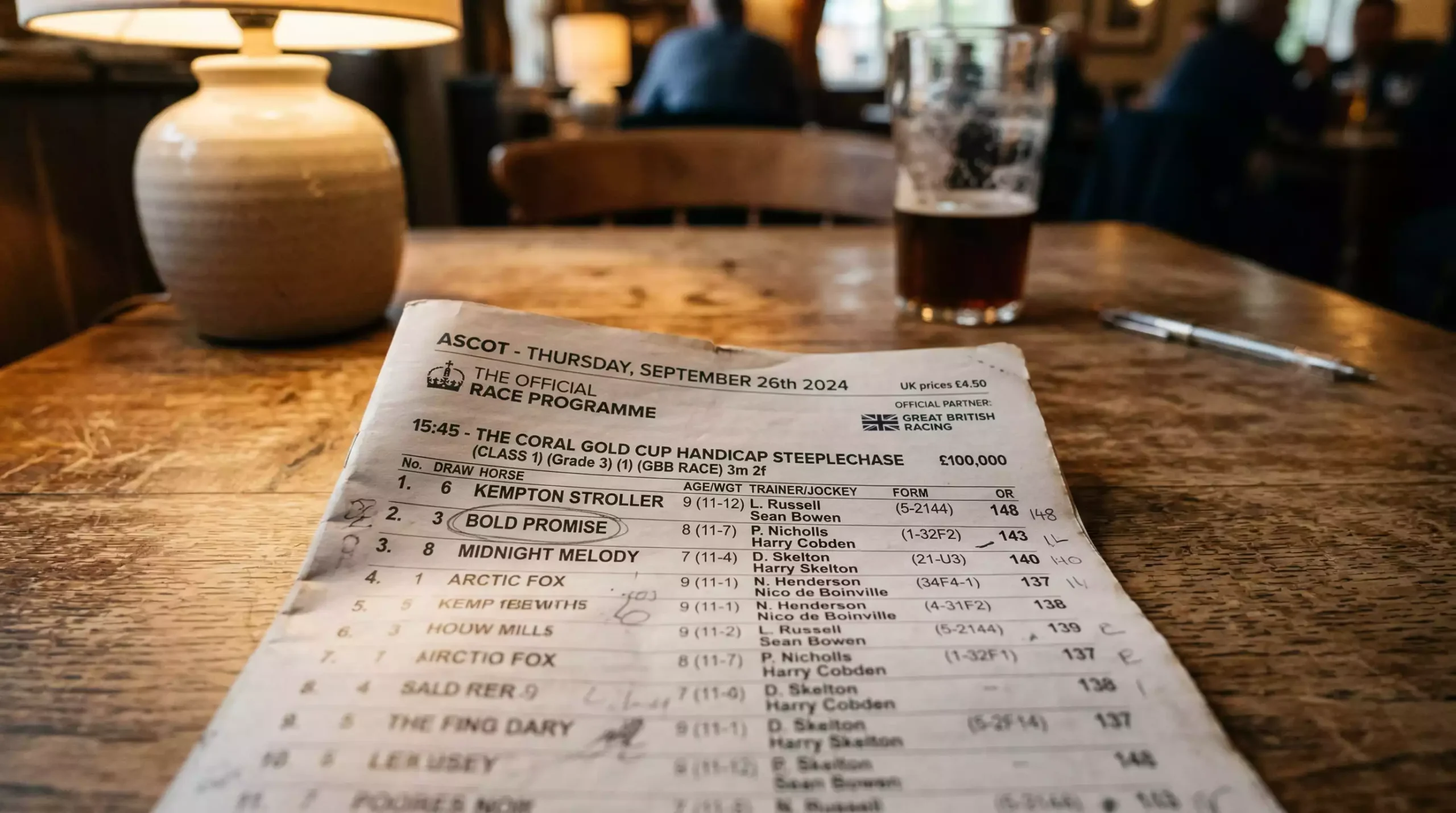
One line of form figures tells a 12-month story — if you know the alphabet. That compressed string of numbers, letters and punctuation sitting next to every horse’s name on a UK racecard is not decoration. It is a performance history written in shorthand, and the punters who can read it fluently have a measurable advantage over those who skip straight to the tips column.
Consider the practical reality: a typical 12-runner handicap at Newbury presents you with twelve separate form strings, each encoding recent finishing positions, seasonal breaks, headgear changes and more. If you cannot decode those symbols quickly, you are either relying on somebody else’s interpretation or gambling without evidence. Neither approach builds an edge. According to analysis by Inform Racing, 75 to 80 percent of all winners come from the top five in the betting market — horses whose form, when read correctly, already points to their chance. The abbreviations are how that form reaches you.
This guide is a reference, not a methodology. It covers every symbol you will encounter on a standard UK racecard: the numbers, the letters, the separators. Once you know what each one means, you can move on to the harder — and more rewarding — work of interpreting what the form actually tells you about a horse’s prospects.
The most prominent part of any form string is the sequence of digits. Each digit represents a finishing position in a completed race, reading from right (most recent) to left (oldest). A horse showing 312 finished second last time out, first the run before that, and third the time before that. Simple enough — until the numbers stop behaving as you expect.
Digits run from 1 through 9 in the obvious way. A horse that finished tenth or worse, however, does not get a two-digit number squeezed into the string. Instead, the form shows 0. This is one of the most commonly misread symbols on a racecard. Zero does not mean the horse did not start. It does not mean disqualification. It means the horse finished outside the first nine. In a 20-runner handicap at a big festival, finishing tenth is hardly a catastrophe. In a five-runner Listed race, it means dead last by a distance. Context is everything.
A few patterns worth recognising early:
The digits are your first filter. They tell you where a horse has been finishing, but they do not tell you why. That context comes from the letters and symbols that sit alongside them.
Letters in a form string replace a finishing position when something happened during a race that makes a numerical result misleading — or impossible. Each letter tells a specific story, and some of them are far more important to your analysis than the numbers.
F — Fell. The horse fell during the race. In National Hunt racing, this is common enough that a single F should not automatically disqualify a horse from consideration. Two or more Fs in recent form, though, suggest a jumping problem that is unlikely to fix itself between Tuesday and Saturday. On the flat, F is extremely rare and almost always indicates a serious incident.
U — Unseated rider. The jockey came off, but the horse did not fall. This is subtly different from F in terms of what it tells you. An unseated rider often points to a horse that jumped adequately but did something unpredictable — pecked on landing, jinked, or was hampered by another runner. It can also mean the horse was travelling well before the incident, which makes U less negative than F in many cases.
P — Pulled up. The jockey stopped riding and pulled the horse out of the race before the finish. Reasons range from injury to exhaustion to being so far behind that continuing served no purpose. A P demands investigation: check the race comments. A horse pulled up because it was never travelling is a different proposition from one pulled up with an irregular action that has since been treated.
R — Refused. The horse refused to race or refused at a fence. In jumps racing, a refusal at a fence can mean the horse lost confidence or was presented badly. On the flat, R usually means the horse planted its feet in the stalls and refused to break. Repeated Rs are a red flag for temperament issues.
S — Slipped up. The horse lost its footing and came down, typically on the flat or on bends. This is relatively uncommon and often weather-related. Unless a horse shows a pattern of slipping — which would be unusual — a single S tells you more about the conditions that day than about the horse.
B — Brought down. The horse was brought down by another runner’s fall. This is critically different from F. A horse marked B may have been running a perfectly good race before being taken out by a faller ahead. Treat B as a non-run rather than a negative.
C — Course winner. This horse has won at the course where it is running today. The C appears in some racecard formats as a superscript or highlighted marker. Course experience matters more at certain tracks than others — Chester, Epsom and Brighton are notorious for rewarding previous course winners because their layouts are so unusual that horses need time to learn them.
D — Distance winner. The horse has won over today’s distance before. Like C, the D marker appears as a supplement to the form figures. When you see both C and D, you have a course-and-distance winner — a factor that punters often overvalue in simple cases but undervalue at quirky tracks.
BF — Beaten favourite. The horse was favourite last time out and lost. This sounds negative, but it is often a contrarian indicator. A 20-year study of UK racing found that favourites win roughly 34 percent of the time. That means roughly two out of every three favourites are beaten. A BF marker flags a horse the market respected — and the reasons for the defeat may no longer apply if conditions have changed.
CD — Course and distance winner. Sometimes shown as a combined marker. This horse has won at this course over this distance. It is one of the most searched-for indicators among casual punters, though its predictive power depends heavily on sample size and how long ago the win occurred.
V — Void race. The race was declared void, so no result was recorded. Treat as a non-run. RO — Ran out. The horse deviated from the course. This is a stronger negative than a refusal because it suggests the horse actively avoided an obstacle or the correct racing line. CO — Carried out. Another horse ran out and carried this horse off the course with it. Like B, treat as something that happened to the horse, not something it chose to do.
Between the digits and letters, you will notice punctuation marks that serve as time markers. These are not cosmetic. They tell you when runs happened relative to seasonal boundaries, and they are essential for judging how current a form string really is.
The hyphen (-). A hyphen separates runs within the same season. If a horse ran three times in the current campaign and you see 21-3, that hyphen simply marks a gap between the most recent run and the two before it. Some racecard formats use hyphens to group runs by calendar periods within a single season.
The slash (/). A forward slash marks the boundary between one racing season and the previous one. A horse showing 12/341 won last time out this season, but the 341 comes from last season or earlier. This matters because horses change between seasons — they mature, they regress, they return from injury. Form from before a slash needs to be treated with caution, especially if the break between the last run of the old season and the first run of the new one was several months.
In practice, a long gap between seasons means you should weigh the post-slash figures more heavily than the pre-slash figures, but you should not ignore the older form entirely. A horse that ran 111 before a slash and 50 after it may be declining — or it may simply need different conditions to reproduce its best.
Brackets. Some racecard providers use brackets to denote form from a previous code. For example, a horse switching from National Hunt to flat racing may have its jumps form enclosed in brackets to signal that those runs were under different rules. This is a useful visual cue because performance often does not transfer cleanly between codes. A horse that ran well over hurdles may struggle on the flat if it lacks the raw speed needed for shorter distances without jumps to break up the pace.
The key principle with all separators is recency. The form closest to today — the right-hand end of the string — carries the most weight. Everything to the left is context, and the further left you go (and the more separators you cross), the less reliable that context becomes.
Below is a complete reference for every standard abbreviation and symbol you will encounter on a UK racecard. Bookmark it. You will need it less often than you think once the symbols become second nature, but there is no shame in checking — the difference between B and BD has cost people money.
| Symbol | Meaning | What It Tells You |
|---|---|---|
| 1–9 | Finishing position (first to ninth) | Where the horse placed in the race |
| 0 | Finished outside the first nine | Unplaced — check field size and class for context |
| F | Fell | Horse fell during the race (jumps — check for pattern) |
| U | Unseated rider | Jockey came off; horse may have been going well |
| P | Pulled up | Stopped before the finish — investigate why |
| R | Refused | Refused to race or jump — temperament concern if repeated |
| S | Slipped up | Lost footing — usually conditions-related |
| B | Brought down | Knocked over by another faller — treat as a non-run |
| BD | Brought down (alternative notation) | Same as B on some racecards |
| RO | Ran out | Left the course — stronger negative than R |
| CO | Carried out | Taken off course by another runner — treat as non-run |
| V | Void race | Race declared void — no result recorded |
| C | Course winner | Has won at today’s course before |
| D | Distance winner | Has won over today’s distance before |
| CD | Course and distance winner | Has won at this course over this distance |
| BF | Beaten favourite | Was favourite last time and lost — check why |
| / | Season separator | Divides current season from previous — older form needs caution |
| – | Run separator | Groups runs within a season or marks a gap |
A few practical notes to finish. First, different racecard providers display these symbols in slightly different formats. Racing Post, Sporting Life, Timeform and At The Races all follow the same fundamental system, but the visual presentation varies — some bold the C and D, others superscript them, and some display BF in a different colour. The meaning is identical regardless of styling.
Second, remember that abbreviations are a language of events, not quality. A horse showing P-F-0 looks awful on paper, but each symbol has a context. The P might have been precautionary after a breathing issue since resolved. The F might have been caused by a faller in front. The 0 might have come in a Group 1 against the best in training. Read the letters, then read the story behind them. That is where the real analysis begins.