
 Available in US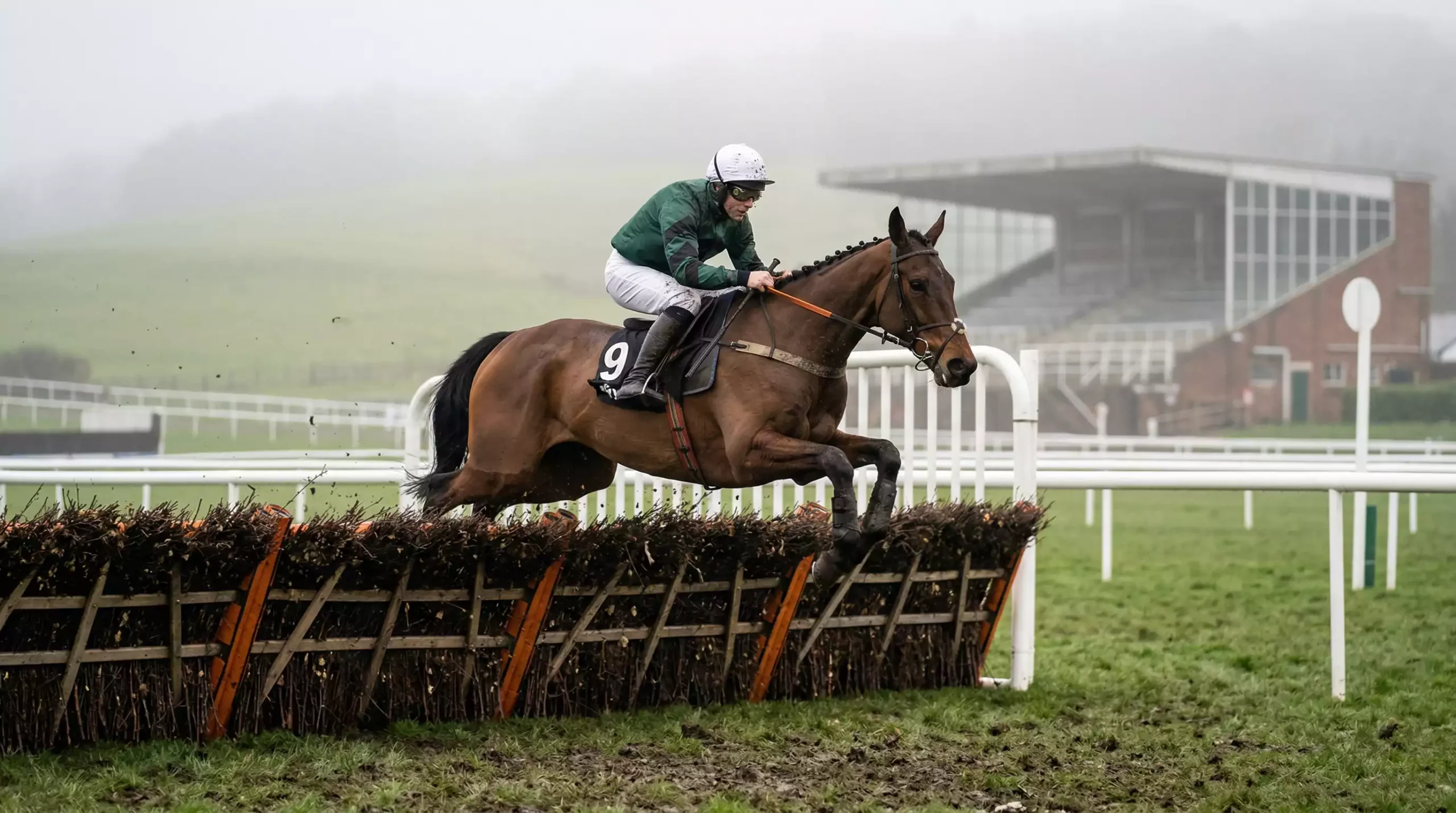
In National Hunt racing, the horse that stays on its feet stays in the argument. That sounds like a joke until you watch a well-fancied favourite crash through the third-last fence and leave your bet in ruins. NH racing introduces variables that simply do not exist on the flat — obstacles, non-completion, the physical attrition of jumping at speed over distances that can stretch beyond four miles. These variables make NH form analysis a genuinely different discipline, not just flat racing with hurdles bolted on.
The punters who do well over jumps are the ones who respect that difference. They read form through a lens that accounts for jumping ability, stamina under pressure, going preference on typically testing surfaces, and the dominant influence of a handful of elite trainers who shape the results of every major meeting. This guide covers the NH-specific factors that matter most and shows you how to build a selection framework tailored to the demands of jumps racing.
National Hunt racing divides into two primary obstacle types, and the distinction matters far more than casual punters realise.
Hurdles are smaller, flexible obstacles — typically about 3 feet 6 inches high — that horses jump at speed with a relatively flat trajectory. Hurdling rewards pace, agility and a bold jumping technique. Horses that are quick over their hurdles gain ground on every obstacle without significantly interrupting their stride. Falls at hurdles are less common than over fences, though they do happen, and the overall completion rate in hurdle races is higher. From a form perspective, hurdling form is closer to flat form than chasing form. Speed figures are more applicable, finishing positions are more reliable as indicators of ability, and the form tends to be more predictable because the jumping element is less decisive.
Chases involve larger, stiffer fences — birch fences on park courses, open ditches, water jumps — that demand a different technique. Chasing is slower, more methodical, and carries a higher risk of error. A horse that is a brilliant hurdler may be a poor chaser if it does not respect the bigger obstacles or if its jumping technique does not adapt. Conversely, horses that are too slow to win over hurdles sometimes flourish over fences because the bigger obstacles break up the gallop and neutralise the speed advantage of quicker rivals.
For punters, the key distinction is completion rate. In novice chases especially, the non-completion rate can be startlingly high — it is not unusual for a quarter or more of the field to fail to finish. This means that when you are assessing chase form, the fact that a horse completed the course is itself a data point. A horse that has finished all of its last five chases, even in modest positions, has demonstrated reliability over fences that a horse with Falls and Pulled Ups in its form has not. In hurdling, completion is less of a differentiator because most horses finish, so the emphasis shifts back towards finishing positions and speed figures.
When a horse transitions from hurdles to fences — a common progression — treat the first few chase starts with caution. The form over hurdles gives you a baseline of ability, but the chasing form will tell you whether that ability translates over bigger obstacles. Watch for horses that jumped fluently in their early chases (check race comments and replay footage) rather than those that blundered through and survived by luck.
National Hunt racing takes place predominantly in autumn, winter and spring — the months when British turf is at its wettest and most testing. According to analysis by BetTurtle, 58 percent of first-quarter races (January to March, the heart of the NH season) run on Soft or heavier going. In the fourth quarter (October to December), the figure is 38 percent. The practical consequence is that going analysis is even more important in NH than on the flat, because the range of conditions is wider and the impact on performance is greater.
Heavy ground fundamentally changes the demands of a NH race. Stamina becomes the dominant factor — horses that rely on speed to outrun their rivals find the going saps their energy before the finishing straight. Jumping technique changes too: take-off and landing surfaces are less predictable on soft ground, and horses that stand off their fences (jumping from further back) tend to cope better than those that get in close, because the soft ground on the landing side absorbs more impact and slows momentum.
For punters, the going filter in NH is non-negotiable. Every horse on your shortlist should have evidence — either from form or from breeding — that it handles the day’s conditions. A horse with sparkling form on Good ground that has never encountered Soft is a risk in a January novice hurdle, no matter how impressive its speed figures look. NH form study starts with the going, because the going determines which version of each horse turns up on the day.
National Hunt racing in Britain and Ireland is shaped by a small number of dominant trainers to a degree that has no parallel on the flat. Understanding their patterns is not optional — it is a core part of NH form analysis.
The numbers tell the story. According to analysis of televised NH races from 2022 to 2024 by BetTurtle, Paul Nicholls led all trainers with 63 wins. Nicky Henderson posted the best strike rate at 19.55 percent. Willie Mullins, the dominant Irish force, compiled an extraordinary record but with a negative ROI of minus 33.41 percent — a reflection of the consistently short prices his runners command.
Nicholls, based at Ditcheat in Somerset, is strongest with chasers and staying types. His horses tend to be well-prepared, fit and ridden by experienced jockeys. Henderson, from Seven Barrows in Lambourn, specialises in high-class hurdlers and is particularly effective with Champion Hurdle types — quick, sharp jumpers that win on class rather than stamina. Mullins operates from Closutton in County Carlow and is the most versatile of the three, capable of winning any race from a bumper to the Gold Cup. His philosophy centres on identifying talent early and managing it carefully towards peak performances at major festivals. As Mullins has said: when you see a horse with ability, you mind that ability and produce it on the days that count. That strategy has made him the most successful NH trainer of his generation.
Beyond the top three, trainers like Dan Skelton, Olly Murphy, Lucinda Russell and Fergal O’Brien have built substantial operations with strong records in the competitive middle tier of NH racing. These trainers may lack the firepower to dominate the championship races at Cheltenham, but in everyday handicaps, novice events and lower-grade races, they are prolific. Skelton’s operation in particular has grown rapidly and his runners deserve the same analytical attention in midweek cards that Nicholls and Henderson receive at the festivals.
The practical application is to weight trainer form more heavily in NH than you would on the flat. A horse from a major NH yard, trained for a specific race, with a jockey booking that signals intent (a top conditional or a retained rider rather than a spare), is a qualitatively different proposition from a horse whose trainer has a 5 percent strike rate and no record at the track. The name on the racecard matters in NH — and the statistics behind the name matter even more.
A workable NH selection framework prioritises the factors that matter most in jumps racing, in descending order of importance.
Going suitability comes first. Check every contender’s record on the prevailing surface. Discard or downgrade any horse without evidence of handling similar conditions. In NH, the going is the race before the race — it determines the shape of the contest before any horse jumps a single obstacle.
Completion record comes second, especially in chases. A horse that routinely fails to finish — whether through falls, refusals or being pulled up — is unreliable regardless of its ability. Check the last five or six runs for the letters F, U, P and R. One incident is forgivable; a pattern is a warning.
Trainer intent comes third. Is this horse running for a purpose, or is it filling a gap in the schedule? A runner from a top yard, entered in a race that matches its profile (distance, grade, going), with a strong jockey booking, signals intent. A runner from the same yard in a race that does not suit, with a claiming jockey, is likely there for education rather than victory.
Class and form provide the final filter. Speed figures are less decisive in NH than on the flat, but they still separate genuine contenders from no-hopers. Recent finishing positions, adjusted for the quality of opposition and the conditions of the race, tell you whether a horse is competitive at its current grade. In novice events, look for progressive form — a horse that improved from its first start to its second, and again from its second to its third, is more attractive than one whose form has plateaued.
Apply these four filters in sequence and you will typically reduce a 12-runner chase or hurdle to three or four genuine contenders. The final selection comes down to price — which of those contenders offers the best value relative to its chance? In NH, where unpredictability is baked into the structure of every race, finding value among the contenders is what turns a solid framework into a profitable method.
