
 Available in US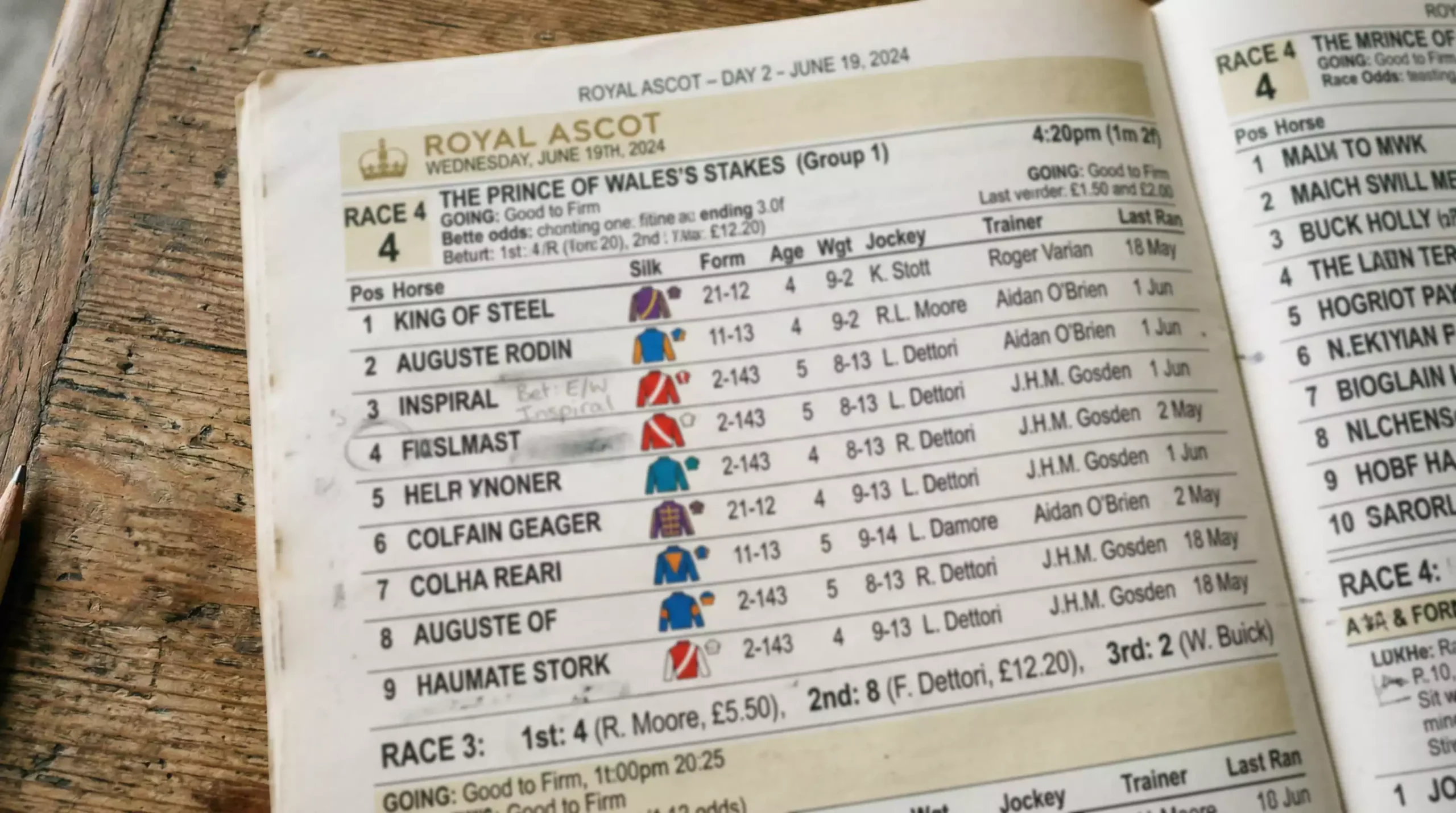
A racecard is a one-page biography of every runner. Here is how to read it. Before you can study form, assess going conditions or compare speed figures, you need to understand the document that delivers all that information: the racecard. It is the starting point of every analysis, and every element on it — from the race header to the smallest equipment notation — exists because it tells you something about the horse, the race, or both.
For newcomers, a racecard can look overwhelming. Numbers, abbreviations, colours, names and symbols packed into dense rows with no obvious hierarchy. This guide walks through every element in the order you will encounter it, explains what each one means, and shows you which details deserve your attention and which are background information you can absorb later as your experience grows.
The top of every racecard contains the race header — the summary of the contest itself, before you look at any individual runner.
Time. The scheduled start time tells you when the race is off. More usefully, it tells you the race’s position on the card. The first and last races of the day are often weaker — trainers save their best runners for the middle of the card where the quality and prize money peak.
Class. The race class (Class 1 through Class 7, or Group/Listed for Pattern races) tells you the quality band. This is one of the most important pieces of information on the entire card because it sets the baseline of competition. A horse dropping from Class 3 to Class 5 is entering weaker company; one stepping up from Class 5 to Class 3 faces a significant challenge. British racing’s total prize fund reached a record £194.7 million in 2025, according to the BHA Racing Report, and the distribution of that prize money mirrors the class structure — Class 1 races carry the richest purses, Class 7 the smallest.
Distance. Expressed in miles and furlongs (e.g. 1m 2f = one mile and two furlongs). The distance tells you what type of horse the race favours — sprinters (5f to 6f), milers (7f to 1m), middle-distance types (1m 2f to 1m 4f) or stayers (1m 6f and beyond). Comparing today’s trip against the horse’s previous winning distances is a fundamental part of form study.
Going. The official going description (Firm, Good to Firm, Good, Good to Soft, Soft, Heavy) appears in the header and tells you the condition of the racing surface. This single word transforms the competitive picture: a horse suited to firm ground may be hopeless on heavy, and vice versa.
Prize money. The total purse indicates the race’s prestige and competitive level. Higher prize money attracts better-prepared runners, which means form from valuable races tends to be more reliable than form from low-prize contests.
Below the race header, each runner gets its own row. The information packed into that row is dense, and every element earns its place.
Cloth number. The number worn on the saddlecloth, used to identify the horse on course or on screen. It is assigned in order and does not carry analytical significance.
Draw. In flat races, the draw number indicates which starting stall the horse will break from. Low numbers are closest to the inside rail; high numbers are furthest out. At certain courses, the draw is decisive. Data from Smarkets shows that 63 percent of winners in five-furlong races at Chester come from stalls one to three — a bias so strong that the draw number on the racecard can matter more than the form figures beside it. In National Hunt racing, there is no draw because horses do not start from stalls.
Silk colours. The colours and pattern of the jockey’s silks identify the horse’s owner. For analytical purposes, silk colours are background information — they tell you who owns the horse, which is occasionally relevant (powerful owners tend to have horses with better trainers and jockeys), but rarely decisive.
Age. Expressed in years (e.g. 3yo = three years old). Age matters more in some race types than others. In flat racing, two-year-olds and three-year-olds improve rapidly between runs. In National Hunt, horses peak later — typically between seven and ten years of age.
Weight. The weight the horse carries, expressed in stones and pounds (e.g. 9st 7lb). In handicaps, weight is allocated by the handicapper based on the horse’s official rating. In conditions races, weight is determined by age and sex allowances. A horse carrying less weight has a physical advantage, particularly over longer distances.
Form figures. The string of numbers and letters next to the horse’s name encodes its recent race history — finishing positions, falls, pull-ups, seasonal breaks. Even at a glance the figures tell you whether a horse has been competitive recently (low digits, ones and twos) or struggling (zeros and high digits). The most recent result is at the right-hand end of the string.
Trainer. The trainer’s name is not just a label. Trainer form — current strike rate, seasonal patterns, course record — directly predicts the horse’s level of preparation. A runner from a yard in a hot streak is a qualitatively different proposition from one whose trainer has sent out 30 losers in a row. Checking trainer form takes seconds on any major racecard provider and is one of the highest-value habits a beginner can develop.
Jockey. The jockey’s name tells you who is riding, and the quality of the booking can itself be informative. A top jockey choosing to ride a particular horse in preference to other options signals confidence from the connections. Conversely, a leading trainer booking a little-known apprentice might indicate the horse is not expected to win but is being given experience. The jockey’s weight claim (if applicable) also appears here: a 3lb, 5lb or 7lb claim reduces the horse’s carried weight.
Owner. Powerful owners — Godolphin, Coolmore, Cheveley Park, Juddmonte — have access to the best trainers, the best breeding stock and the best jockeys. A runner carrying a major owner’s colours is more likely to be well-prepared and well-targeted than one from a smaller operation. This is a probability, not a rule — but in form study, probabilities are what matter.
The final layer of racecard information covers equipment and supplementary notes that can make the difference between a bet and a pass.
Headgear. Blinkers, cheekpieces, visors, tongue ties and hoods are all listed on the racecard, typically as abbreviations. Headgear serves different purposes: blinkers restrict peripheral vision to help a horse concentrate; cheekpieces encourage keener racing; tongue ties prevent breathing issues; hoods calm nervous horses in the paddock. The application of headgear for the first time is a significant form factor — it signals the trainer is trying something new, often because the horse has been underperforming. First-time blinkers, in particular, produce a measurable uplift in performance across UK racing as a whole.
Official rating (OR). In handicaps, the horse’s official rating appears on the card. This number determines the weight carried and reflects the handicapper’s assessment of ability. Comparing the OR to the horse’s recent speed figures tells you whether the mark is generous (speed figures above the OR) or harsh (speed figures below it).
Race comments and tips. Some racecards include a brief comment from the card compiler — a sentence or two offering a view on the horse’s chance. These are opinions, not data, and should be treated accordingly. They can serve as a starting point for investigation but should never substitute for your own analysis. The racecard gives you every element you need to form your own view. The real skill is learning to read it yourself.
