
Loading...
Before the jockey picks a line, the draw has already picked the odds.
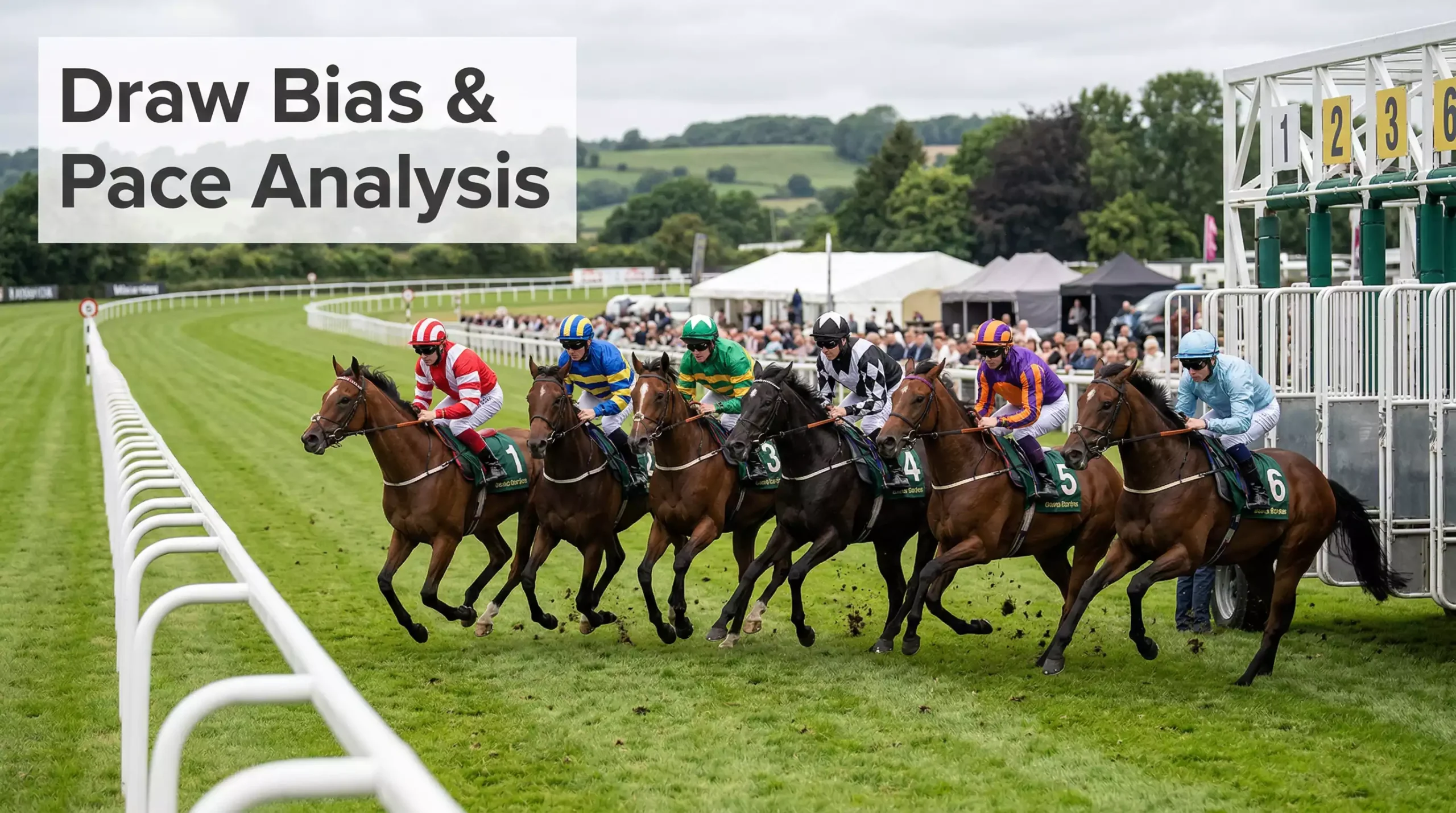
At Chester, 63 percent of winners over five furlongs come from stalls one, two and three. That is not a trend, a quirk, or a sample-size artefact — it is a structural feature of the track, documented by Smarkets across years of results. If you backed every horse drawn in stalls four through twelve in those races, you were betting against geometry. The tight left-handed bend that comes barely a furlong after the start forces wide-drawn horses to cover extra ground, burn extra energy, and arrive at the straight with less to give. No amount of ability fully compensates for running two or three lengths further than the horse in stall one.
Pace works differently but produces equally measurable effects. The shape of a race — how fast it is run in the early stages, where the pressure comes, when the sprint for home begins — determines which running styles prosper. In some races, front-runners control the tempo and are never caught. In others, a fast early pace collapses the leaders and hands the race to closers who were biding their time at the rear. These outcomes are not random. They follow patterns tied to field size, course layout, and the tactical tendencies of the horses involved.
Draw and pace are linked. The stall a horse draws from influences where it can position itself in the early stages, which in turn determines whether it can execute its preferred running style. A front-runner drawn widest at Chester faces a compounding disadvantage: the draw costs ground, and the effort to overcome the draw costs energy that would otherwise fuel the finish. This guide examines both variables — draw bias and pace analysis — as the interconnected forces they are, with course-specific data that most competitors in this space either omit or mention only in passing.
Draw bias exists when a horse’s starting position — the stall it leaves from — has a measurable effect on its chance of winning, independent of ability. On a perfectly symmetrical course with a long straight run to the first bend, the draw would be irrelevant: every horse would cover the same distance regardless of stall. British racing has very few perfectly symmetrical courses. Most tracks have bends, cambers, undulations, and drainage patterns that create advantages for certain starting positions over others.
The bias is most pronounced in sprint races — five and six furlongs — because the distance from the stalls to the first bend is short. In a five-furlong race at a tight track, a horse drawn in stall twelve may need to travel two or three lengths further than a horse in stall one just to negotiate the first turn. Over five furlongs, those extra lengths represent a significant percentage of the total race distance. Over a mile and a half, the same extra distance is proportionally trivial. This is why draw bias is primarily a sprint and mile phenomenon, and why it diminishes as the race distance increases.
The Smarkets analysis of Chester quantifies the effect starkly. Over five furlongs, 63 percent of winners come from stalls one, two and three. Fifty-five percent of all placed horses come from those same three stalls. Only 24 percent of beaten favourites from wider draws managed to win — meaning that even market-leading form was routinely overcome by the disadvantage of a high draw. These are not marginal differences. They represent a course where the draw is arguably the most important variable in the race.
Data from LightSpeed Stats extends the picture beyond Chester. At Catterick, stalls one through three in sprint races outperform their expected win rate by approximately 40 percent. At Thirsk, horses drawn in the upper third of the stall allocation win around 45 percent of sprint races, against an expected rate of 33 percent if the draw were neutral. These courses share a common trait: tight bends that come early in the race and penalise wide-drawn runners.
Not every course produces significant draw bias. Tracks with long straights — Ascot’s straight mile, Newmarket’s Rowley Mile, the straight courses at Doncaster and York — tend to show minimal or no draw effect because there is no bend to negotiate in the early stages. On these courses, the ability of the horse, the going, and the pace scenario are far more important than the stall number.
Even at courses with known bias, the effect is not constant. Ground conditions can shift the advantage. When the going is soft, the ground near the rail (where low-drawn horses run) may be more churned up than the ground further out, reducing or even reversing the usual low-draw advantage. The number of runners matters too — in small fields of six or seven, the draw is less significant because all horses have room to manoeuvre. In fields of 16 or more, the wide-drawn runners face a genuine physical disadvantage that no amount of jockeyship fully offsets.
The skill is knowing which courses, at which distances, under which conditions, produce a bias worth acting on — and which do not. That requires data, not instinct.
Knowing that draw bias exists is step one. Knowing exactly where it exists, at which distances, and by how much is what makes it usable. Here is the data for the UK courses where the draw has the most documented effect.
Chester is the poster child for draw bias in British racing, and for good reason. The track is a tight, left-handed oval barely a mile in circumference, with sharp bends that come early and often. Over five furlongs, the low-draw dominance documented above is as extreme as anything in British flat racing. At six furlongs and seven furlongs, the bias persists but softens — the additional distance before the first bend gives wide-drawn horses fractionally more time to find a position. Over a mile, the draw still matters at Chester, but form and ability begin to assert themselves more strongly.
Chester is also one of the few UK courses where front-runners have a measurably higher win rate than the national average. Timeform data cited by LightSpeed Stats shows front-runners winning approximately 25 percent of races at Chester, compared to a national average of roughly 15 percent. The tight bends and short straights mean that a horse on the lead coming off the final bend has a significant positional advantage that is difficult to overhaul. This compounds the draw effect: a front-runner from a low draw at Chester is in the best possible position, both literally and statistically.
Catterick is a sharp, undulating left-handed track in North Yorkshire where sprint races produce a consistent low-draw advantage. LightSpeed Stats data shows stalls one through three outperforming expected win rates by around 40 percent in sprints. The course layout is the cause: the five-furlong start feeds almost immediately into a left-handed bend, and wide-drawn horses lose ground before they have found their stride. The effect is strongest in large fields — ten or more runners — where the width of the field exaggerates the distance differential.
Thirsk is a flat, left-handed oval that produces draw bias at sprint distances, though the pattern is slightly different from Chester and Catterick. At Thirsk, horses drawn in the upper third — the higher stall numbers — win approximately 45 percent of sprint races, against an expected rate of 33 percent if the draw were neutral. The bias favours high draws because the course configuration allows wide-drawn horses to get to the rail quickly, and the ground near the stands’ rail tends to ride faster. This is the opposite of the Chester pattern, and it catches punters who assume that low draws are always advantageous.
For context, here are courses where draw data shows little or no significant effect at standard distances: Newmarket (Rowley Mile and July Course), Ascot (straight course), Doncaster (straight mile), York (over a mile), and Goodwood (at longer distances). At these tracks, form, going, and pace are the dominant variables, and the stall number is background noise. The punter who adjusts for draw at Ascot’s straight mile is wasting analytical energy. The punter who ignores draw at Chester is throwing money away.
The practical rule: always check draw stats for the specific course and distance before assessing a sprint or mile race. Most racing databases — Timeform, Racing Post, LightSpeed Stats — carry historical draw data. A two-minute check can tell you whether the draw is a factor today or whether you can safely ignore it.
Every race has a shape. That shape — the pace scenario — is determined by how fast the early fractions are run and how the energy expenditure distributes across the field. Understanding pace separates the punter who reads form from the punter who reads races.
Horses run in three broad styles. Front-runners break quickly from the stalls, take up the lead, and try to control the race from the front. Hold-up horses settle in midfield, conserve energy during the early stages, and quicken in the closing stages. Closers sit at the rear, rely on a fast finish, and attempt to overhaul the leaders in the final furlong or two. Each style has strengths and weaknesses, and each is more or less effective depending on the pace of the race around it.
Research compiled by LightSpeed Stats quantifies the advantages. Data from Nick Mordin’s work on pace analysis shows that lone front-runners — horses that lead the field without pressure from a rival — outperform their expected win rate by approximately 35 percent. The logic is straightforward: a horse that controls the pace without being challenged can dictate the tempo, conserve energy by running at its own rhythm, and force every other horse in the field to make up ground in the closing stages. When no other horse wants the lead, the front-runner gets a free ride.
At the other end of the field, closers in fast-paced races outperform expected win rates by around 30 percent. When the early pace is hot — two or three front-runners racing for the lead, none willing to concede — the leaders exhaust themselves before the home straight. The energy they spend fighting for position is energy they do not have for the finish. Closers, sitting quietly at the back, inherit the race as the leaders come back to them. James Quinn’s pace figures, also cited by LightSpeed Stats, document this pattern across thousands of UK races.
A pace map is a pre-race prediction of where each horse is likely to sit during the early stages. You build it by reviewing each runner’s historical running position: does this horse typically lead, sit handy, or come from behind? Most racing databases flag running style, and race replays confirm it. Once you know the likely positions, you can predict the scenario.
If the race contains one clear front-runner and no other pace horse, the front-runner has a tactical advantage. It will dictate a tempo that suits it, and the rest of the field will be forced to race on its terms. If the race contains three or four pace horses, the early fractions will be fast, and the tactical advantage shifts to hold-up horses and closers who can exploit the leaders’ fatigue.
Simon Rowlands addressed the physics of this dynamic directly when he noted that basic principles of bioenergetics tell us a horse that expends energy in a non-optimal way will compromise its overall speed across the full race distance. That principle, explained in a discussion on Betfair’s Timeform debate, is the scientific basis for pace analysis. A horse that races too fast too early is wasting energy. A horse that races too slowly early may not have time to make up ground. The optimal pace strategy depends on the horse’s physiology, the distance, and the competition for the lead.
Draw and pace are not separate variables. They interact, and the interaction can be more powerful than either factor alone. The stall a horse draws from determines whether it can execute its preferred running style — and when it cannot, the cost is measurable.
The clearest example comes from Chester. Nick Mordin’s analysis, cited by LightSpeed Stats, found that front-runners drawn in stalls one through three at Chester win approximately 35 percent of their races. Front-runners drawn in wider stalls win fewer than 10 percent. The same running style, the same course, the same distance — but a difference of 25 percentage points in win rate based solely on starting position. The wide-drawn front-runner has to use extra energy to cross to the rail and take the lead, and that energy deficit shows up in the final furlong when the horse empties sooner than it would from a favourable draw.
The compound effect works in reverse too. A closer drawn on the inside at a course with a strong low-draw bias gains nothing from the draw advantage because closers do not need an early positional benefit — they are deliberately dropping to the rear. The draw advantage is wasted on a horse whose style does not exploit it. Meanwhile, the same closer might benefit from a wide draw at a track like Newmarket’s July Course, where hold-up horses drawn wide can make their challenge down the centre of the track, away from the potentially slower ground near the rail. LightSpeed Stats data shows hold-up horses at the July Course outperforming national averages by roughly 20 percent — a pace-related edge at a course where the draw itself is not a major factor.
Before any sprint or mile race at a course with known draw bias, run through this sequence. First, identify the front-runners in the field and check their stall numbers. A front-runner from a low draw at a low-draw-advantage course is a compound positive. A front-runner from a high draw at the same course is a compound negative. Second, count the pace horses. If there is only one front-runner and it has a favourable draw, the compound advantage is at its maximum — it will lead unchallenged from the best position. If there are three front-runners, the pace will be fast regardless of draw, and the advantage shifts to closers.
Third, consider the going. On soft ground, the rail can be the worst part of the track if earlier races have chewed it up. A low-drawn front-runner that would normally benefit may find itself running on the most damaged surface. In those conditions, the draw advantage diminishes or disappears, and the pace scenario becomes the dominant variable.
The punter who integrates draw and pace into a single assessment is working with a three-dimensional view of the race. The punter who checks the draw and ignores the pace — or analyses the pace and ignores the draw — is looking at a flat photograph of something that moves.
Draw and pace analysis adds a layer to form study that most punters skip. Here is how to build it into your routine without doubling the time you spend on each race.
For any flat race at a mile or shorter, check the course draw statistics before you assess the form. This takes less than a minute. If the data shows a significant bias — a win rate difference of 10 percent or more between favoured and unfavoured stalls — flag it. Any horse in your shortlist drawn on the wrong side of the bias needs to overcome a structural disadvantage. If the bias is strong, as at Chester or Catterick, consider removing unfavourably drawn horses from your shortlist entirely. If the bias is moderate, keep them on the list but adjust your confidence downward.
For pace, scan the field for running styles. Identify the likely front-runners using historical position data. Count them. If there is one clear leader, that horse has a tactical edge. If there are three or more pace horses, expect a fast early tempo and give additional weight to hold-up runners and closers. You do not need to build a sophisticated pace model — a simple count of pace horses and an assessment of the likely tempo is enough to shift your assessment in the right direction.
The best plays arise when draw, pace, and form all point in the same direction. A horse with strong recent form, a favourable draw, and a running style that fits the likely pace scenario is a triple-positive selection. These alignments do not appear in every race — in most races, the draw is neutral, the pace is uncertain, and form is the dominant consideration. But in the races where the alignment exists, the edge is genuine and the market frequently underprices it because most punters do not perform the analysis.
The worst plays — the ones to avoid — are where the form looks attractive but the draw and pace work against the horse. A front-runner with a wide draw at Chester in a race with three other pace horses is fighting the geometry of the course and the dynamics of the race simultaneously. Its form figures are irrelevant if the conditions prevent it from running its race. Recognising these negative compounds saves money more reliably than identifying positive ones makes money, because the losses you avoid are certain while the winners you find are probabilistic.
Record your draw and pace assessments alongside your form notes. Over time, you will build a personal database of which courses, distances, and scenarios produce the most reliable draw and pace effects. That database — specific to the races you bet on and refined by your own results — becomes more valuable than any generic guide, because it reflects the conditions you actually encounter rather than a national average.
Before the jockey picks a line, the draw has already picked the odds. Before the pace unfolds, the field composition has already determined who benefits and who does not. The punter who sees both layers — and acts on them — is reading a different race from the punter who sees only the form.